Here are the main points for making healthier food choices:
Healthy eating means eating many different foods in the right amounts to help you feel good.
Try to eat at least five portions of different vegetables and fruits every day to help lower the chance of heart disease.
Make your meals mainly with whole grains like brown rice and wholewheat pasta to get more fibre.
Use official dietary guidelines to make a balanced plate with all the main food groups.
Cut down on food high in fat, sugar, and salt. Eat these less often and only in small amounts.
Introduction
Have you ever asked yourself what it really means to eat well? Following healthy eating habits is an important part of caring for your health and can help you feel great. It is about knowing nutrition and picking the right dietary patterns. This means eating a variety of foods in the right amounts to keep a healthy weight. Making good food choices gives your body the nutrients it needs to grow, heal, and stay strong.
The Ultimate List of Healthy Food Choices
Creating a balanced diet is easier than you may think. Healthy eating means including a mix of foods from each main food group. Picture filling your plate with colourful and healthy options that your body will enjoy. The best way to get a wide range of nutrients is to pick different kinds of food.
According to dietary guidelines, your meals should focus on starchy foods like whole grains, along with plenty of fruits and vegetables. Below, we will look at some of the best foods to include in a healthy diet to help you get started on your journey.
1. Leafy Green Vegetables
Eating different kinds of vegetables is one of the best things you can do for your health. Leafy greens like spinach and kale are full of important nutrients and have great health benefits. Eating them is linked to a lower chance of serious problems like heart disease and can help control your blood pressure.
Choosing fresh foods instead of processed ones means you get all the good stuff without extra additives. Fresh vegetables give you vitamins and minerals in their natural form, without the added salt and sugar often found in processed foods. They should make up a little more than a third of what you eat each day.
Here are some simple ways to add more greens to your meals:
Add a side salad to your lunch.
Include some vegetables with your evening meal.
Mix spinach into smoothies or pasta sauces for an extra nutrient boost.
2. Colourful Fruits
Fruits, like vegetables, are a key part of a balanced diet. Eating a variety of fruit helps you get many vitamins and minerals. The dietary guidelines say you should eat at least five portions of fruit and vegetables every day. Colourful fruits are an easy and tasty way to reach this goal. They are one of the best foods to have in a healthy diet.
Whether fresh, frozen, or canned, fruits give you fibre and natural sweetness. Studies show that people who eat plenty of fruit have a lower chance of stroke and some types of cancer. One apple, banana, or pear counts as one portion, so it is easy to keep track of how much you eat.
Here is how to add more fruit to your day:
Swap your morning biscuit for a banana.
Enjoy fresh fruit with plain, lower-fat yoghurt for dessert.
3. Whole Grains
Making your meals with whole grains is an easy change that gives you many health benefits. Whole grains have more fibre, vitamins, and minerals than refined grains like white bread and white rice. Picking fresh, unprocessed foods such as whole grains helps you avoid the lower nutrient content found in processed foods.
Foods like brown rice, oats, and quinoa are great options. The fibre in whole grains helps you stay full for longer and can also lower cholesterol in your blood. Starchy foods should make up more than a third of your diet, so building your meals around them is a good plan.
Try these simple swaps:
Choose brown rice instead of white rice.
Pick wholewheat pasta.
Go for brown, wholemeal, or higher-fibre bread instead of white bread.
4. Lean Proteins
Protein is very important for your body to grow and fix itself. It is important to pick the right types of protein. Lean proteins are some of the best foods to eat for a healthy diet. This food group includes lean meats, poultry without skin, seafood, eggs, beans, and lentils. These foods are not only good sources of protein but also give you many needed vitamins and minerals.
When you eat meat, choose lean cuts and poultry without skin to lower the amount of fat you eat. It is also better to eat less red and processed meat, such as bacon and sausages. Fish, especially oily fish like salmon, contains fatty acids called omega-3, which are good for your heart. Try to eat at least two servings of fish each week.
Here are some top protein choices:
Lean meats and skinless poultry
Fish and other seafood
Beans, peas, and lentils
5. Nuts and Seeds
Are you looking for healthy snacks that also fill you up? Nuts and seeds are a great option. They have lots of fibre and healthy unsaturated fats, including good fatty acids. These fats are important for your diet and can help lower cholesterol.
Nuts and seeds are good for you but they have a lot of energy. So, you should eat them in moderation. Unsalted nuts make a good snack to keep you going between meals. Having nuts, seeds, and other healthy foods ready makes it easier to choose good snacks every day.
Here are some ideas to add nuts and seeds to your diet:
Grab a small handful of unsalted nuts for a quick snack.
Sprinkle seeds on your yoghurt or salad for extra crunch and nutrients.
How to Identify Truly Healthy Foods
Walking through the supermarket can be hard when you want to eat healthily. How can you know if a food product is really healthy just by looking at its packaging? Many processed foods use smart marketing, but their nutrient content might show a different picture. It is important to look beyond the claims on the front of the box.
Knowing how to read food labels is a useful skill. It helps you choose the right foods for you and your family. In the sections below, we will show you how to read nutrition information and find hidden ingredients.
Reading Nutrition Labels
Knowing how to read a nutrition label is a great way to make healthier choices. The label shows key info about a food’s nutrition. This includes calories, fat, sugar, and salt. Watching these numbers can help you control what you eat and reach your health goals.
When looking at the label, check the amount of saturated fat. Too much can raise your cholesterol. Also, look at the sugar content to keep your blood sugar in control. Remember to read the ingredient list. It tells you what is in the product. Ingredients are listed by amount, so the first ones are the main parts of the food.
Watch out for:
Serving size: The nutrition details often show one serving, not the full package.
Sugars and fats: Compare products and pick those with less of these.
Spotting Hidden Sugars and Fats
Many foods that seem healthy can hide a lot of sugar and saturated fat. Eating foods and drinks with high sugar often can raise your chances of obesity and tooth decay. Also, eating too much saturated fat can cause high cholesterol. This raises the risk of heart disease.
To find these hidden sugars and fats, you need to be like a detective. Sugar can be listed under many names, like corn syrup, dextrose, and fructose. Saturated fat is often in processed meats, pastries, and some dairy products. Checking the nutrient content carefully helps you avoid these risks. This can lower your chance of problems like diabetes.
Here’s what to watch for:
Sugary drinks: Fruit juices and sodas usually have a lot of sugar. Choose water or low-fat milk instead.
Processed snacks: Foods such as crisps and biscuits tend to be high in both fat and salt.
Building a Balanced Plate
So, what does a balanced diet look like according to health experts? A balanced plate is about getting the right amounts of different foods. Picture your plate split into parts for each food group. This simple idea helps you get a good mix of nutrients in every meal.
Official dietary guidelines, like the NHS Eatwell Guide, give a clear example of this. They show how much you should eat from each food group to have a healthy, balanced diet. The next sections will talk more about portion sizes and how these guidelines work.
Portion Guidance from Health Experts
Portion control is a crucial part of maintaining a healthy weight and diet. Eating the right amount of food helps you manage your intake of calories and avoid overeating. Even healthy foods should be eaten in appropriate quantities. Dietary guidelines from health experts provide helpful recommendations for portion sizes.
For example, a portion of fruit or vegetables is around 80g. For dried fruit, a portion is 30g. Thinking about your hand can be a useful guide: a handful of nuts or a palm-sized piece of meat is often a good reference. Being mindful of portions doesn’t mean you need to feel deprived; it’s about balance.
Here is a simple guide based on the Eatwell Guide’s proportions for a balanced diet:
Food Group
Recommended Plate Proportion
Fruits and Vegetables
Just over 1/3 of your plate
Starchy Carbohydrates (Wholegrain)
Just over 1/3 of your plate
Proteins (Lean meat, fish, beans)
A moderate portion
Dairy and Alternatives
Small portions
Oils and Spreads
Use in small amounts
The Role of Official Dietary Guidelines
Are there any official guides or plates to help create a healthy meal? Yes, there are. Health groups worldwide give dietary guidelines to help people make healthier choices. In the UK, the NHS Eatwell Guide is the main tool. In the United States, the USDA has a similar guide called MyPlate.
These guidelines make healthy eating easy and clear. They show what you should eat during a day or a week using simple food groups. The main idea is to eat a range of foods to get the nutrients your body needs.
The main points of these dietary guidelines are:
Balance: Eat the right mix of food groups.
Moderation: Eat foods high in fat, salt, and sugar less often and in small amounts.
Simple Tips for Enjoying Healthy Eating Every Day
Making healthy eating enjoyable is the best way to keep it up. How can you make it fun for the whole family? Try getting everyone involved, from planning the meals to cooking them. Having regular family meals is a great chance to connect and show good eating habits.
Focus on adding more good things, such as a variety of fruit and vegetables, instead of just cutting things out. Remember, moderation is key; you don’t have to stop favourite treats completely. Below, you will find some easy recipe ideas that are perfect for busy families.
Easy Healthy Recipes for Busy Families
Finding healthy recipes that are quick and easy can be hard on busy days. But with some planning, you can make nutritious meals that everyone will enjoy. Letting your children help choose what to have for dinner can also make mealtimes more fun for them.
For a healthy lunchbox, think of ideas together. You might pack whole-grain crackers with cheese, vegetable sticks with hummus, or a pot of low-fat dairy yoghurt. A good snack does not have to be hard. Fresh fruit, celery sticks with peanut butter, or a small handful of nuts are all good choices.
Here are a few simple ideas:
Quick pasta: Use wholewheat pasta with a simple tomato sauce and add lots of veggies like peas and sweetcorn.
Jacket potatoes: A classic for a reason! Top with beans, tuna, or cottage cheese.
Stir-fries: Quickly cook lean protein and many colourful veggies with brown rice or noodles.
Conclusion
To sum up, choosing healthy foods is not just about following trends. It is about living a way of life that helps your health. By adding leafy greens, bright fruits, whole grains, lean proteins, and nuts to your meals, you create a path to better health. It is important to check nutrition labels and watch out for hidden sugars and fats. This can really change your choices. When you make a balanced plate, think about portion sizes and follow dietary guidelines to get the best from your meals. Eating healthy can be easy and enjoyable, helping you feel your best every day. If you want to take the next step to a healthier you, please get in touch for a free consultation today!
Frequently Asked Questions
What are the main differences between healthy and unhealthy foods?
Healthy foods have lots of good nutrients like vitamins, minerals, and fibre. They usually have low levels of sugar, salt, and saturated fat. On the other hand, unhealthy and processed foods often lack these good nutrients and have high amounts of sugar, salt, and saturated fat. Eating healthy food can help you lower the risk of heart disease.
Which healthy foods should I always keep in my kitchen?
To make healthy eating easier, always keep your kitchen stocked with basics like leafy greens and other vegetables, fruits, whole grains such as oats and brown rice, and lean proteins like eggs and beans. It is also a good idea to have low-fat dairy products and healthy snacks like unsalted nuts ready to eat.
Can you give me a simple daily meal plan using only healthy foods?
For a simple, balanced diet, begin your day with whole grains such as porridge. At lunch, eat a big salad that has a variety of vegetables and a lean protein source like chicken or lentils. For dinner, make a plate with some fish, lots of vegetables, and a small portion of whole grains.
Here’s a quick look at what this guide offers you:
Healthy eating means picking a mix of foods full of nutrients.
A balanced diet has fruits, vegetables, whole grains, lean proteins, and good fats.
Making smart food choices brings many health benefits, like more energy.
Eating well can lower the chance of getting chronic diseases.
A healthy diet is important for managing your weight well.
You can easily include more healthy foods in your day with simple swaps.
Introduction
Have you ever thought about what it really means to eat healthily? It’s not about strict diets or cutting out the foods you enjoy. Healthy eating is about feeling good, having more energy, and boosting your wellbeing. By making a balanced diet with tasty and nutritious foods, you can take a big step to support your overall health. This guide will help you see how easy and enjoyable it can be to make good changes to your daily meals.
The Ultimate List of Healthy Food Choices for Everyday Eating
Building your diet around different healthy foods is one of the best ways to take care of your body. Eating whole foods from each main food group helps you get the vitamins and minerals needed for good health. This way of eating can help you feel better and lower your chance of long-term health problems like heart disease.
Are you wondering which foods to add to your meals? The list below shows some of the most nutritious and flexible options you can try. From bright fruits to lean proteins, these choices can help stop chronic diseases and support your well-being.
1. Fresh Fruits and Berries
Fruits and berries are nature’s sweet treat and a great part of any healthy eating plan. They are full of antioxidants, vitamins, and fibre. This makes them a smart choice for a snack or dessert. The best part is they need very little preparation, so you can enjoy them anytime.
Adding more fresh fruit to your diet can really increase your intake of important nutrients. For example, oranges are well known for their vitamin C. Bananas give you a good source of potassium. Eating a variety of fruits helps you get many benefits for your overall health.
Try adding these fruits to your shopping list:
Apples: A good source of fibre and vitamin C, making them a very filling snack.
Strawberries: Low in calories but high in manganese, fibre, and vitamin C.
Blueberries: Tasty and full of strong antioxidant compounds.
Avocados: Different from other fruits because they have healthy fats, potassium, and fibre.
2. Leafy Green Vegetables
When we talk about healthy foods that are full of nutrients, leafy green vegetables are right at the top. They have very few calories but are full of essential vitamins like vitamin C and minerals that help keep you healthy. Adding these greens to your meals is an easy way to increase your nutrient intake.
Eating leafy greens such as spinach and kale regularly can help your overall health. Studies show that a diet rich in these vegetables can lower the risk of heart disease and other long-term health problems. Their high fibre also helps keep your digestion healthy.
Here are some popular leafy green vegetables to try:
Kale: High in fibre, vitamin C, and vitamin K. It works well in salads or baked as crispy chips.
Broccoli: A great source of fibre and vitamins C and K, with a good amount of protein.
Spinach: Full of nutrients and antioxidants that support eye health and reduce damage from stress.
Cucumbers: Fresh and watery, they mainly contain water and vitamin K.
3. Whole Grains
Choosing whole grains is an easy change that can bring big health benefits. Unlike the refined grains in white bread, whole grains keep the whole grain kernel. This means they have more nutrients. They also have higher fibre, which helps you feel full for longer.
Making brown rice, oats, and wholewheat pasta your main carbs gives your body a steady energy supply. The extra grams of fiber in these foods also help with good digestion and can lower cholesterol. They are an important part of a balanced, filling diet.
Look for these whole grains when you shop next time:
Brown Rice: Has more nutrients than white rice, including fibre, vitamin B1, and magnesium.
Oats: Have a strong fibre called beta-glucan that helps reduce cholesterol.
Quinoa: A full plant-based protein, high in fibre and many minerals.
Ezekiel Bread: Made from organic, sprouted whole grains and legumes for top nutrition.
4. Lean Proteins (Chicken, Turkey, Fish)
Protein is important for building and fixing body tissues. Choosing lean protein foods helps keep a balanced diet. Foods like chicken breast and turkey have low fat and calories. They are a good source of protein that helps you feel full and happy after eating.
Eating fish at least twice a week is a good idea. You should include a portion of oily fish. The NHS says oily fish is full of omega-3 fatty acids. These fats are good for heart health. [Source: https://www.nhs.uk/live-well/eat-well/food-types/fish-and-shellfish-nutrition/] They also help the brain work well.
Here are some great lean protein foods:
Chicken Breast: A lean and flexible source of high-quality protein.
Salmon: An oily fish rich in protein and heart-friendly omega-3 fatty acids.
Tuna: Low in fat and high in protein, great for salads and sandwiches.
Lean Beef: Provides iron that the body can use easily when eaten in small amounts.
5. Legumes and Pulses
Legumes and pulses like beans, lentils, and peas are very good for your health. They are a great plant-based source of protein and have a good amount of fibre, which helps you feel full. Adding them to your meals is an easy way to follow healthy eating advice and increase your nutrient intake.
Legumes have many health benefits. Their high fibre helps your digestion and controls blood sugar levels. Also, they are an affordable way to add flavour and bulk to soups, salads, and main meals. This makes healthy eating possible for everyone.
Try these useful legumes and pulses:
Lentils: Full of fibre and plant protein, ideal for soups and stews.
Kidney Beans: A good source of vitamins and minerals, but make sure to cook them well.
Green Beans: A common vegetable that you can eat cooked as a side or raw in salads.
Peanuts: Although a legume, they are packed with nutrients and antioxidants.
6. Nuts and Seeds
Don’t be tricked by their small size; nuts and seeds are full of good nutrients. They are a great source of healthy fats, protein, and essential vitamins. Even though they have a lot of calories, a small handful can be a filling snack that helps control hunger between meals.
Many nuts and seeds offer special health benefits. For example, almonds are full of vitamin E, an antioxidant that helps protect your cells from harm. Chia seeds have a lot of fibre and fatty acids like omega-3. Adding them to your meals is an easy way to get more useful nutrients.
Keep these nuts and seeds handy for a quick snack:
Almonds: Full of vitamin E, magnesium, and fibre.
Walnuts: High in fibre and many vitamins and minerals.
Chia Seeds: A food rich in nutrients with fibre, magnesium, and calcium.
Macadamia Nuts: Delicious nuts rich in healthy monounsaturated fats.
7. Low-Fat Dairy Options
For people who can have them, dairy products are a good source of important nutrients. Choosing low-fat options lets you enjoy the benefits without too much saturated fat. Dairy is well known for its high calcium, which is needed for strong bones and teeth.
Including low-fat dairy in your meals can also help with weight management. The protein in yoghurt and milk helps you feel full. This can stop you from eating less healthy snacks. Some dairy products also have added vitamin D. This helps your body take in calcium better.
Try these low-fat dairy options:
Yoghurt: Pick plain, low-fat yoghurt with live cultures for good probiotics.
Low-Fat Milk: A good source of calcium, protein, and vitamins.
Cheese: Provides protein, but choose less processed types and eat in small amounts.
Cottage Cheese: Has a lot of protein and not many calories.
8. Healthy Fats and Oils (Olive Oil, Avocado)
Fat is an important part of a healthy diet, but the type of fat you pick is important. Unsaturated fats, which you can find in foods like olive oil and avocados, are very good for your health. These healthy fats can lower the chance of heart disease when you use them instead of saturated fats.
Extra virgin olive oil, for example, has a lot of monounsaturated fats and antioxidants that give strong health benefits. Avocados are also a great source of healthy fatty acids, fibre, and potassium. Changing butter for these choices is an easy way to live a healthier life.
Add these healthy fats to your meals:
Extra Virgin Olive Oil: A heart-friendly oil great for salad dressings and cooking.
Avocados: Smooth and tasty, full of healthy fats and good nutrients.
Nuts and Seeds: Give a good mix of healthy fats, protein, and fibre.
Oily Fish: Like salmon and mackerel, which have lots of omega-3 fatty acids.
Simple Tips to Make Healthier Food Choices Every Day
Are you ready to begin your healthy eating journey? The good news is that you don’t need to change your whole diet all at once. Making small, steady changes to your daily eating habits can bring big benefits. These healthier choices can help you control your weight, increase your energy, and lower high blood pressure.
To make this easier, you can use simple tools like the NHS Eatwell Guide to see what a balanced meal looks like. [Source: https://www.nhs.uk/live-well/eat-well/the-eatwell-guide/] Here are some practical, easy tips to help you plan meals, shop smarter, and cook in ways that improve your health.
1. Plan Balanced Meals Using the Plate Method
Have you heard about the plate method? It is a simple way to make a balanced diet without counting calories. By following the Eatwell Guide, you can make sure each meal has a healthy mix from every main food group. This will help with your healthy eating goals.
Picture your plate split into parts. The biggest parts should have vegetables and starchy foods, ideally wholegrain. A smaller part should have protein, and you should put only small amounts of high-fat or high-sugar foods on your plate. This way, making healthy meals is easy and natural.
Here is how to build your plate:
Fill half your plate with fruits and vegetables: Try to include many different colours.
Fill a quarter with higher fibre starchy foods: Think of brown rice or potatoes with their skins.
Fill a quarter with lean protein: Like fish, chicken, or beans.
Add a small portion of dairy or alternatives.
2. Read Nutrition Labels for Smart Shopping
Understanding the nutrition facts label is like having a secret weapon for making healthier choices at the supermarket. These labels tell you exactly what’s in your food, helping you compare products and pick the best options for your health.
When you look at a label, pay close attention to the amount of saturated fat, sugar, and how much salt is listed per 100g. This helps you quickly see if a food is high or low in these ingredients. Also, look for the grams of fiber—choosing foods with more fibre can help keep you full and support good digestion.
Here is a simple guide to understanding food labels:
How you cook your food is just as important as the healthy foods you choose. Some ways of cooking add extra fat and calories, while others help keep the good nutrients in your ingredients. Making simple changes to how you prepare food is a big step in your healthy eating journey.
Instead of frying, which needs large amounts of oil, try methods that use less saturated fat. Grilling, baking, and steaming are great choices that bring out the natural flavours of food without adding extra calories. These methods also help keep more vitamins and minerals.
Try these healthier cooking methods:
Steaming: Keeps the most nutrients in vegetables.
Grilling: Lets fat drip away from meat, cutting down its fat content.
Roasting: Brings out the sweetness in vegetables using only small amounts of oil.
Stir-frying: A quick way that uses little oil and keeps vegetables crisp.
Essential Healthy Foods to Always Keep in Your Kitchen
Having a kitchen full of good food is your best way to avoid unhealthy choices. When you keep healthy ingredients ready, you are more likely to eat a healthy diet and not grab convenience foods. Having staples like whole grains, lean proteins, and healthy snacks makes cooking meals easy and less stressful.
By keeping these important foods, you make sure you always have what you need for essential vitamins and can quickly make a meal or snack. From a bowl of oats in the morning to a handful of nuts in the afternoon, these foods help you stay on track for a healthy diet.
1. Quick-Prep Staples for Nutritious Meals
Life can be busy, but that does not mean your good nutrition has to stop. Keeping quick-prep staples in your pantry and fridge helps you make healthy meals fast. These are basic foods that you can use to make many healthy dishes with little work.
Think about foods like canned beans, frozen vegetables, and whole grains. A sweet potato can cook quickly in the microwave. Pre-cooked brown rice or wholewheat pasta can also be ready very fast. Having these foods in your kitchen stops you from needing to order takeaways on busy nights.
Stock your kitchen with these quick-prep staples:
Canned Beans and Lentils: Add protein and fibre to salads, soups, or tacos.
Frozen Fruits and Vegetables: Just as healthy as fresh ones and great for smoothies or side dishes.
Whole Grains: Keep oats, quinoa, and brown rice for quick, filling meals.
Eggs: A fast and flexible source of good protein.
2. Healthy Snack Options for Busy Days
When you feel hungry between meals, having healthy snacks ready can really help. The right snack can keep your energy steady and stop you from eating too much at your next meal. The best snacks give you nutrients and satisfaction but have fewer calories than processed treats.
Instead of picking crisps or biscuits, choose whole foods. Fresh fruit, a small handful of nuts, or a pot of low-fat yoghurt are great options. These snacks give you fibre, protein, and healthy fats to keep you full and full of energy.
Keep these healthy snacks handy for when you need them:
Fresh Fruit: Apples, bananas, and oranges are easy to carry and need no work.
Nuts and Seeds: A small handful gives you healthy fats and protein.
Greek Yoghurt: It has lots of protein and makes a filling snack.
Vegetable Sticks with Hummus: Crunchy, tasty, and full of nutrients.
Conclusion
Making healthy food choices is not just a trend; it is a way of life that helps your overall health. By adding fresh fruits, leafy greens, whole grains, and lean proteins to your meals, you can build a balanced and nourishing diet that fuels both your body and mind. Remember, small changes can bring big results over time. It is important to pay attention to what you eat, read nutrition labels, and try new healthy cooking methods to keep your meals interesting. Enjoy the path of healthy eating, and do not hesitate to ask for help. If you want to improve your healthy eating journey, get a free consultation with our experts today!
Frequently Asked Questions
What makes a food ‘healthy’ and how can I spot it on labels?
Healthy foods are usually whole foods that have lots of nutrients and very little added sugar, salt, or bad fat. To find them, look at the nutrition facts label. Choose foods that have low saturated fat and high fibre. This follows general dietary guidelines for a balanced diet.
How do government guidelines shape healthy eating habits?
Government dietary guidelines, like the NHS Eatwell Guide, show a clear picture of a balanced diet. This nutrition policy helps people see how much of each food group to eat for healthy eating. It makes it easier to create nutritious meals and build good habits for life.
What are some easy healthy recipes for beginners?
For easy and healthy recipes, try meals like grilled chicken or fish served with roasted vegetables and quinoa. Another good choice is a simple lentil soup with whole-grain bread. These meals mix lean protein foods, whole grains, and lots of vegetables to make a balanced and filling dish.
It’s changing the way we work, create, and interact online. Almost every post we see today has a high chance of being AI-generated.
The global AI market is projected to surpass $826 billion by 2030. AI-powered writing tools are growing at a 25% CAGR, and AI image generators are expanding at 17.5% CAGR through 2032.
Yes, AI makes life easier. It saves us time, money, and effort.
But are we all becoming increasingly dependent on AI?
Think about it.
Need gift ideas? Ask AI.
Don’t know the meaning of a word? Ask AI.
Don’t have the right opening sentence? Ask AI.
I’m sure everyone, from educators to policymakers, is guilty of this.
But they’re also turning to AI detection tools to protect against fraud.
In this article, I’ll break down 10 AI detection tools I’ve tested, along with why you should start using them in your daily routine.
Affiliate Disclosure: This post contains affiliate links. If you purchase through them, I may earn a small commission at no extra cost to you. I only recommend products I trust or use myself. Your support keeps my content journey going — thank you!
🙌 Additional author’s note: For some tools, I received complimentary access for review purposes, but all testing, reviews, and opinions are my own.
Best AI Detectors to Identify AI-Generated Content in 2025 (Reviewed & Ranked)
Let’s look at some AI detector tools you might want to consider.
1. QuillBot
QuillBot is one of the popular tools among writers as it is easy to use and gives accurate results.
This tool lets you detect AI-generated text, humanize text, correct Grammar, find citations, check Plagiarism, manage projects, and whatnot.
Let’s explore its AI Detector tool first.
How to detect AI text using QuillBot
Here’s how you can access the AI detector of QuillBot:
I purchased their premium plan to check all the tools.
If you want to purchase the premium plan or check the pricing, click on “QuillBot Premium” in the left panel. You can just tap on the “Upgrade” button to buy it.
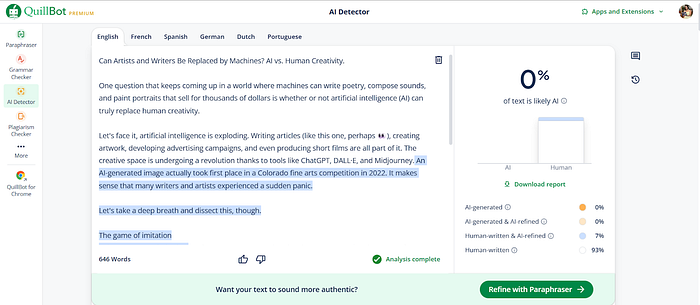
I have pasted the same ChatGPT-generated text in QuillBot’s AI Detector.
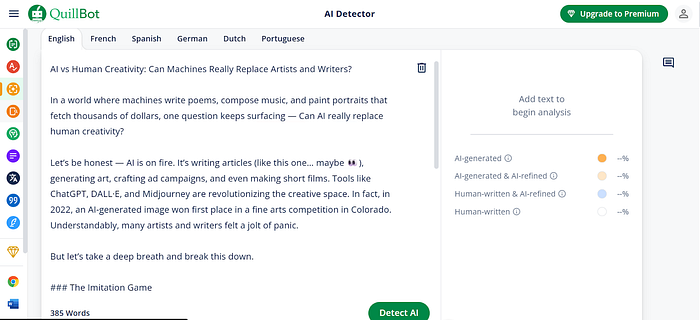
The result shows 78% AI-generated — works well.
I am going to paste the same text in AI Humanizer and check its accuracy. In the left panel, go to “More” for more tools and select AI Humanizer.
QuillBot gives the Basic and Advanced modes for humanizing AI-generated content.
The resulting text sounds humane.
Let’s check whether the humanized text passes the AI Detector test or not.
I have copied and pasted the humanized text into the AI Detector.
Let’s see the results.
Nice! The QuillBot Humanizer beats its own AI Detector.
Why not try its AI Detector with actual human-written content?
Again, I am checking one of my articles, and hopefully it will be accurate.
As expected, 0% AI-generated text.
QuillBot’s AI Detector surpassed all my tests, and I am quite happy with both the free and premium versions. I am also going to add its extension now.
Other AI tools in the QuillBot suite
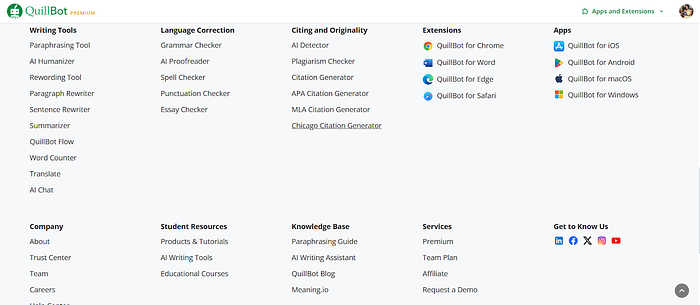
QuillBot provides a good collection of AI tools to enhance your content.
There are mainly eight tools:
Paraphrasing tool
Grammar Checker
Plagiarism Checker
AI Detector
AI Humanizer
Translate
Summarizer
Citation Generator
As you scroll down, there are different categories of cool tools for you to explore.
You can also get QuillBot’s extensions for Chrome, Word, Edge, or Safari. It’s free.
Or, you can download the QuillBot app for your mobile phone.
I liked the QuillBot Flow, basically a next-generation word-processor tool, to manage projects.
It also provides various templates like Literature Review, Appendix, Index, Harvard, Newsletter, Resume, Project Proposal, and many more.
These tools and templates can make writing easy for anyone.
Pricing
When it comes to pricing, QuillBot is quite affordable.
You can get the premium plan for just $4.17 per month, billed annually. QuillBot also offers a 3-day money-back guarantee in case you don’t want the premium plan.
QuillBot Premium allows unlimited paraphrasing, advanced Grammar recommendations, humanizes text in advanced mode, unlimited access to AI Detector, and many more features.
If you’re an entrepreneur, you can get the team plan for your organization.
The best thing is that you can pause your subscription anytime you want.
QuillBot’s AI Detector is accurate when it comes to AI detection. I am satisfied with the results and happy to include QuillBot in my collection of tools.
It’s easy to use, and the free version works well too. It has several tools to write flawlessly, like AI Detector, Plagiarism Checker, Humanizer, Word counter, Spell Checker, and others.
QuillBot is suitable for writers, students, teachers, employees, and those who want to write accurately and improve their writing skills.
2. Winston AI
Winston AI is the only AI detector with a 99.98% accuracy rate. This tool can be used by educational institutions, for SEO, and to improve your content’s authenticity.
Let’s use a sample text from Gemini this time. What I liked is that you can get a 14-day, 2,000-word scan trial for free, and you don’t need a credit card to sign up. This tool gives you a chance to test out the features for a decent amount of time before deciding whether to purchase it.
Results
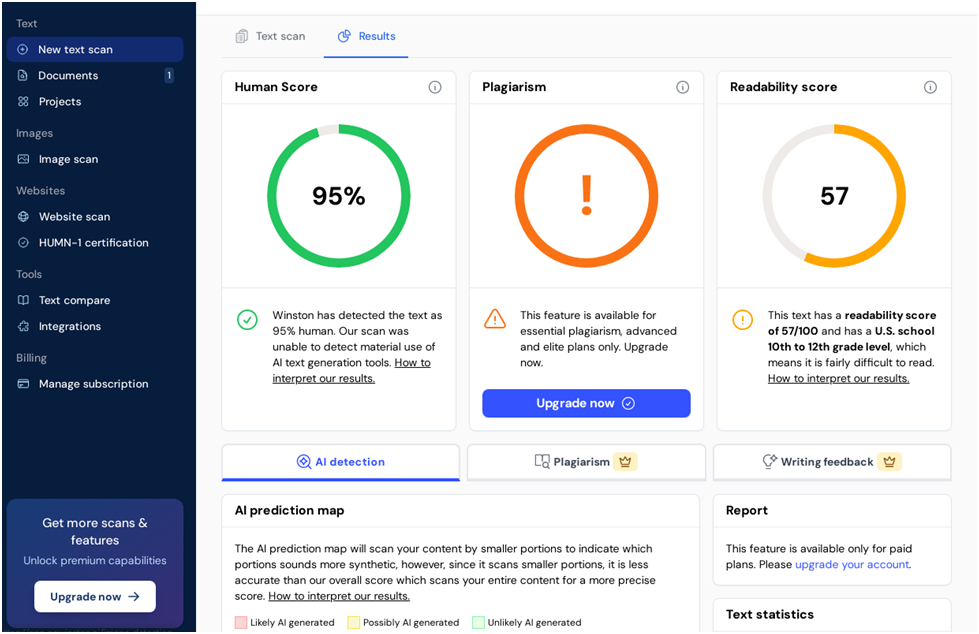
Well, the tool works pretty well for a passage generated by Gemini.
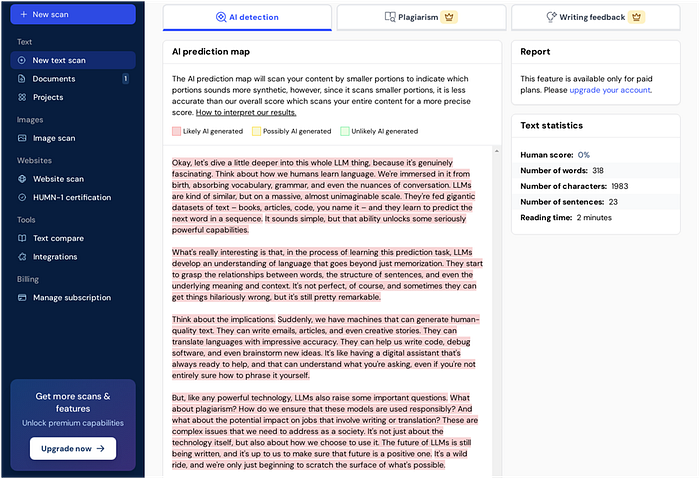
You need to upgrade in order to use the Plagiarism detector tool or get writing feedback.
Let’s test this tool on one of my articles (100% human-written).
95% is a pretty good score when it comes to AI detectors.
How to detect AI images using Winston AI
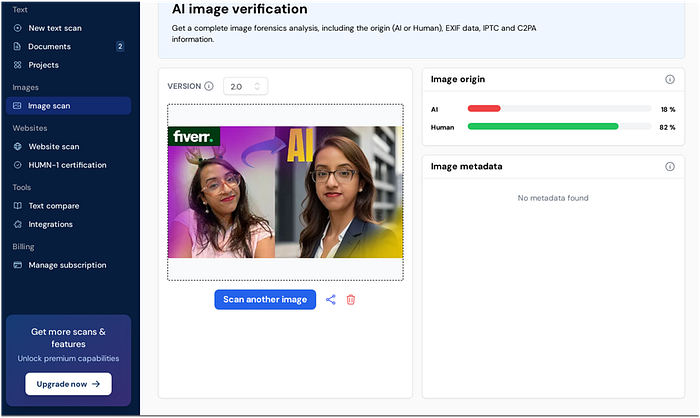
Winston AI also has an “Image Scan” tool. Each scan costs 300 credits. I’m going to put this tool to the test using an image where one side contains a real selfie of mine, while the other has an AI-generated headshot. Let’s see if Winston AI can provide the right analysis.
Well, this is pretty interesting. I did edit the picture myself, so I guess Winston AI is correct in identifying the origin as human. Or perhaps the AI-generated headshot is so accurate that it’s evading detection by AI tools?
Winston AI also provides a certification — HUMN1 — to prove that the content on your blog is human-generated. You can integrate this with a WordPress plugin or use an XML sitemap.
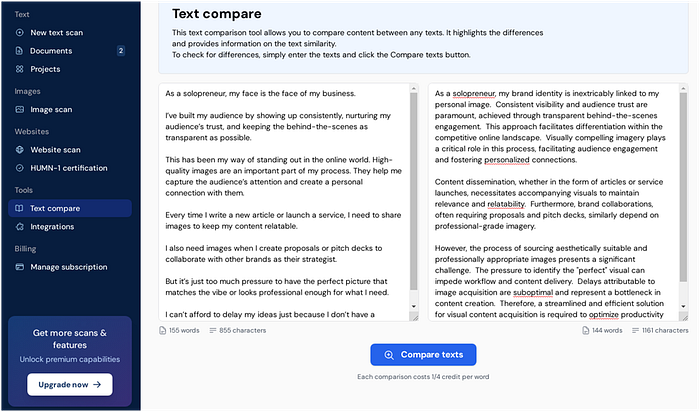
Next, I’m testing out the “Text Compare” tool. Each comparison costs ¼ credits per word. On the left side, I’ve added a passage from my own article, and on the right, I’ve added the AI-generated version of the same passage.
Here’s what I got.
Only 5% similarity with the AI-generated version. That’s good news, right? This tool can help you analyze different writing styles, choose the best version, or even help you identify repeated sentences and words.
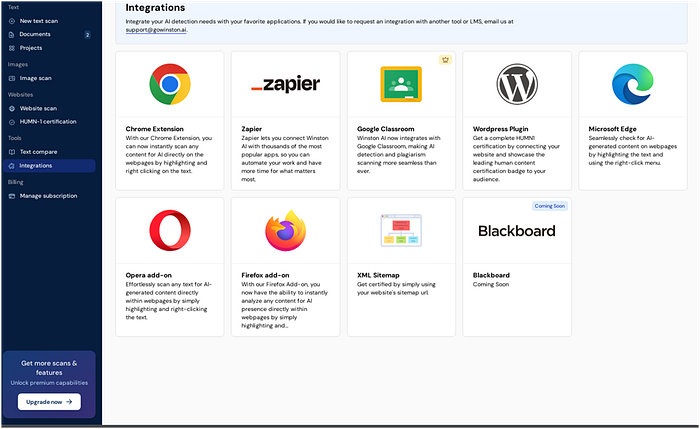
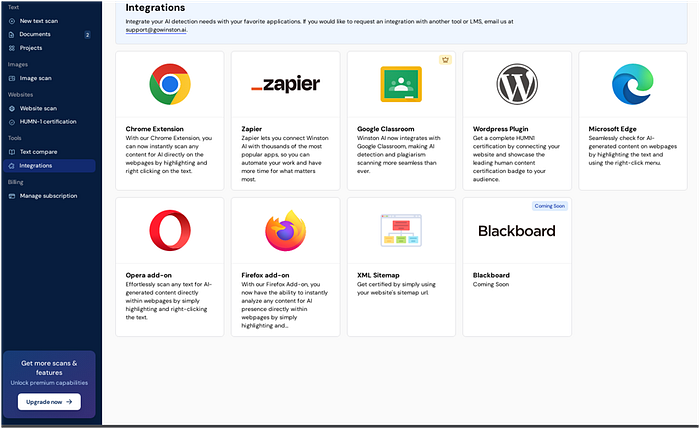
Winston AI can be easily integrated with Google Chrome, Zapier, Google Classroom, Microsoft Edge, and many others to make your work life much easier.
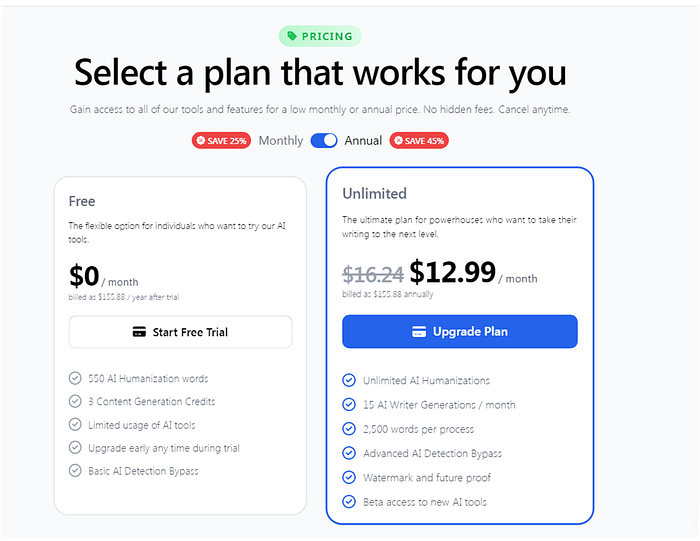
The “Free” plan has a ton of options to choose from. If you’d like to try out their other tools like AI writer and AI humanizer, the “Unlimited” plan is pretty affordable, at just $12.99 per month.
I’d say the AI detector, content generator, and humanizer work perfectly well. I’m pretty impressed, actually. For the level of accuracy this tool provides, I think the pricing is quite reasonable. Definitely Phrasly.AI is one of the best humanizers I’ve used so far.
3. Proofademic
Proofademic is an academic AI detector that instantly detects content written using ChatGPT, Gemini, and other AI tools.
This tool can be used to detect AI-generated text in academic essays, papers, and articles. Proofademic also offers multi-language support, including French, Spanish, and more.
As I mentioned earlier, once you’ve signed up, simply paste your content into the blank space under “New Document”. You can also upload a complete document for scanning.
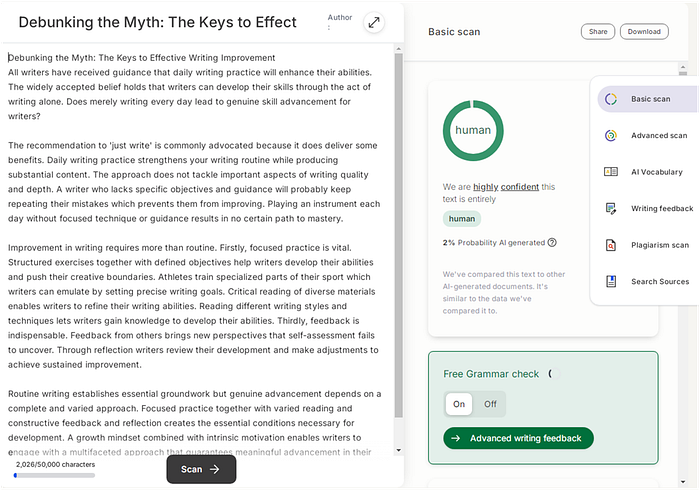
I tested two passages generated by ChatGPT and Gemini, along with one passage from an article I originally wrote. What stood out immediately was the tool’s smooth UI. Pretty simple, hassle-free, and easy to navigate.
Results
Well, the generated article is fully AI-generated, and Phrasly.AI admits it. See the lines highlighted in red? That means those lines are AI-generated.
Let’s try and humanize it.
Well, that looks pretty clean. I know what to do next. Let’s test it out on GPTZero to see if it can actually bypass AI detectors.
It works! That’s amazing. The passage humanized by Phrasly.AI did bypass GPTZero’s AI detector. This is pretty cool, isn’t it?
Pricing
4. Pangram Labs
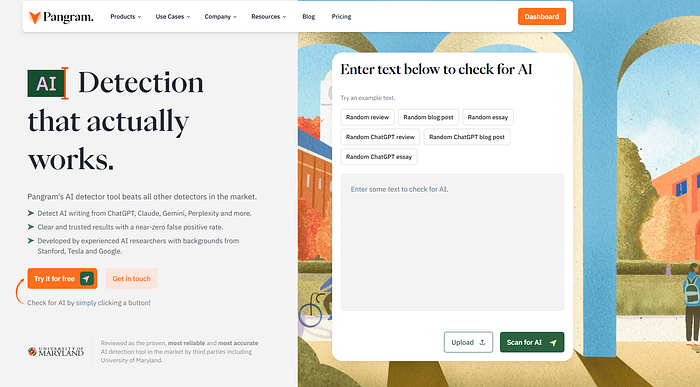
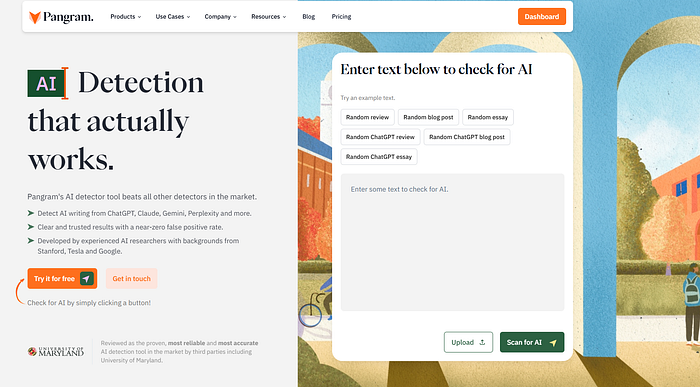
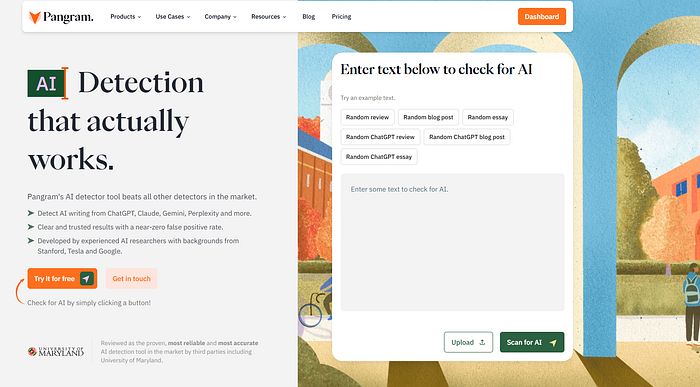
Pangram Labs claims that its AI detector is better than all other detectors out there in the market. This tool has been reviewed by the University of Maryland and has an impressive list of clients such as Quora, Featured, American Association for Cancer Research, and more.
The homepage looks pretty good. Maintains a nice balance between colors, spacing, and typography, and feels well-organized. For me, aesthetics and usability are equally important.
You can either paste your text or upload a file. I tested this tool using a passage generated by DeepSeek. You can also check for plagiarism simultaneously by clicking on “Check for plagiarism”.
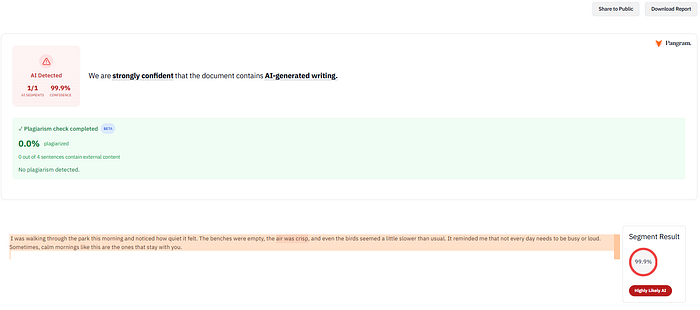
The passage showed 100% AI but 0% plagiarism. That’s because it was a fictional passage generated.
Now, let’s try testing a passage from one of my articles.
No AI detected, which is absolutely correct. You can also share this generated report in public to gain credibility or download it.
The “AI Phrases Tool” points out all the phrases that are commonly used by AI. I used a passage generated by ChatGPT this time, and here’s what I got.
You can see that Pangram Labs has clearly highlighted the phrases most likely to be used by AI content generators or LLMs.
Pangram Labs also lets you compare texts side by side to spot similar phrases. For instance, I used a passage from one of my articles and asked ChatGPT to enhance it. Now, let’s compare the two. This cost me 1 credit.
This can be really useful if you’re confused about finding specific terms inside your long essays or research papers, and to check whether all the relevant keywords have been added or not.
Pangram Labs also has a Chrome extension and can be integrated with Google Classroom and Canvas.
What I also like about this tool is the detailed blogs mentioned on the dashboard. These blogs can help you understand how things work and give a perception of AI detection.
Pricing
5. Detecting-AI
Detecting-AI is a hub of tools required for content creation and analysis. It claims to identify AI-generated text by ChatGPT, Gemini, Jasper, Claude, and other similar models.
Let’s test its AI Detector and other tools.
How to detect AI text using Detecting AI
Here’s how to leverage this wonderful AI Detecting tool:
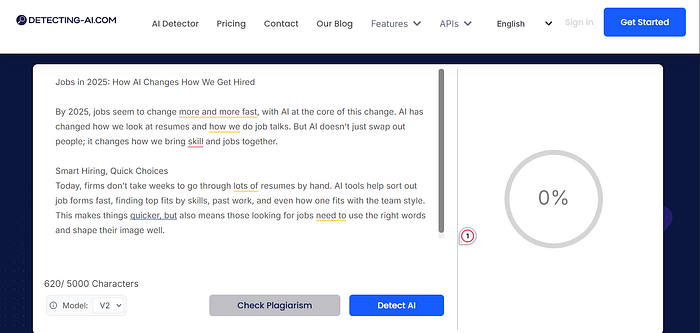
You’ll see the AI Detector tool right at the top of the homepage.
The best thing about this tool is that you can detect AI without signing in and for free.
Now let’s test if this free tool is really worth it. Later, we’ll explore its paid version as well.
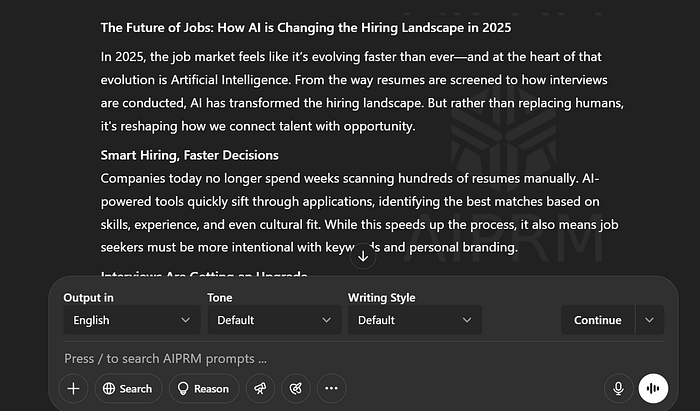
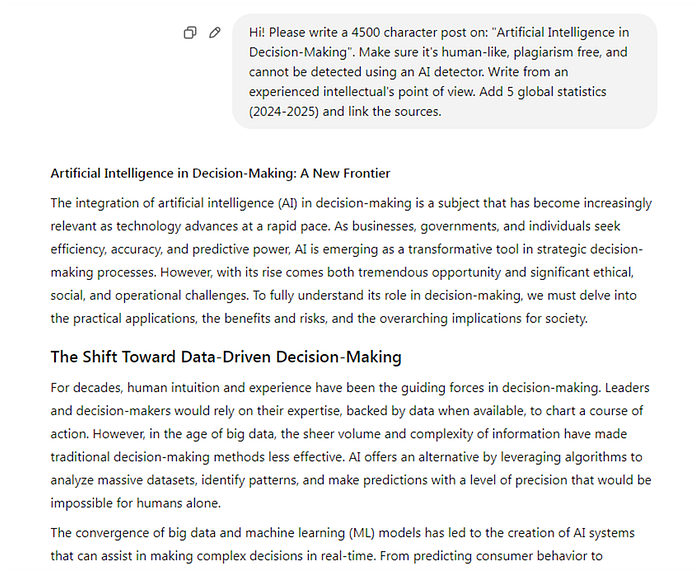
I asked ChatGPT, which utilizes generative artificial intelligence, to write a short and human-like article for me:
Let’s check whether Detecting-AI can tell if this article is AI-generated or not.
You can just paste the text or upload the file in .txt, .doc, .docx, or PDF format. I copied the text from ChatGPT and pasted it into the blank space.
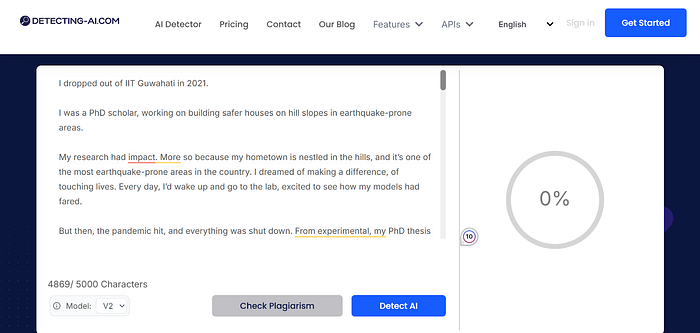
Note that you can upload up to 5000 characters and also change the model version from V1 to V2.
Now tap on “Detect AI”.
AI text detection results
Here are the results:
The free version marked this text as 95.2% AI generated — pretty accurate.
Apart from English, Detecting-AI supports many languages like French, Dutch, Russian, German, Portuguese, Spanish, and Arabic, using natural language processing capabilities for efficient detection.
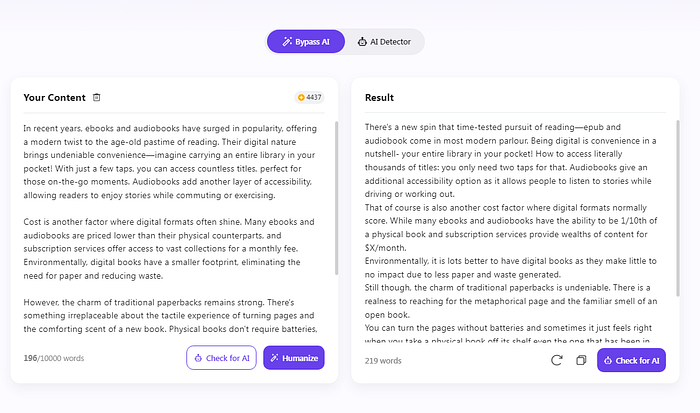
Now let’s try to humanize this AI-written content.
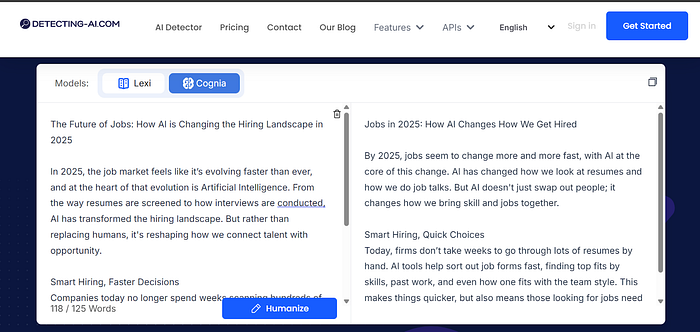
Oh snap! For the free version, we can humanize up to 125 words at once.
Let’s add the first two paragraphs and see the results.
Sounds more human. Let me copy and paste the humanized text again in the AI detector for comparison with a large language model.
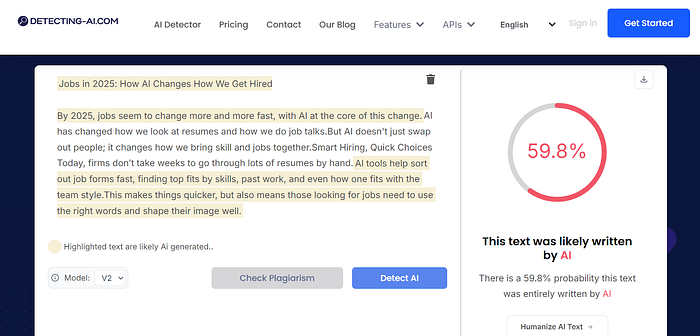
And this is what I got.
59.8% written by AI! It shows that this text was likely written by AI, which is true.
This free version passed my tests, and the results are pretty good so far.
Again, let’s paste this humanized text on GPTZero.
Great! It shows “Possible AI paraphrasing detected”. I am quite happy with the results of GPTZero.
It’s time to test Detecting-AI with actual human-written content. I am pasting one of my articles. FYI, it’s 100% human-generated.
Oops! This time it failed. It showed the text as 72.1% AI-written.
I purchased Detecting-AI‘s monthly plan to check the credibility of AI Detector and other tools.
If you want to purchase a plan, you can go to ‘Pricing’ at top of the homepage, select your desired plan, and click on ‘Get Started’. Then you can sign in using Gmail and make the payment.
Now let’s see how well AI Detector works in the paid version, especially with any new models.
I will paste an AI-generated text first (from ChatGPT).
You can select different tools to analyse your text, like AI Detecting, Readability, Plagiarism, and more.
Click on ‘Run Selected Scans’ and here we go.
The Analysis Result shows potentially AI (67%).
In the right panel, you can see the analysis results of your selected tools, such as Readability and Plagiarism, by clicking on different icons.
Let’s try its Humanizer tool and check the results again.
Tap on the Humanize Text in AI Content Analysis.
Now, click on Check For AI. Let’s see what it says.
Likely human-written with a 24% score. Nice!
I’d like to use a paragraph from one of my articles (100% human-written) and see if it works.
Well, not so satisfactory. It marked the text as 63% AI. This seems to be a pretty common problem in all AI detectors. A lot of human-written text is marked as AI. I wouldn’t worry so much about changing it, as long as it feels authentic to me.
APIs
Detecting-AI has plenty of useful API tools like AI Detector API, AI Humanizer API, and Plagiarism Checker API. Additionally, the AI writing detector feature can enhance your ability to assess the authenticity of content.
Based on your requirement, you can seamlessly integrate any API into your workflow. The AI Detector API can be handy for reviewing academic papers, social media posts, or blogs.
I’ve discussed the pricing for APIs in the later sections.
Other AI tools in the Detecting-AI suite
Detecting-AI provides a bunch of tools to analyse content, including an AI checker.
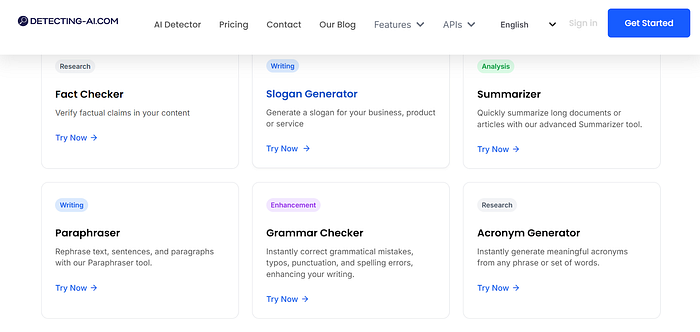
If you go to the ‘features’ on the homepage, you will find tools like AI Detector, Plagiarism Checker, Fact Checker, AI Humanizer, and Other AI Tools.
But if you want to use Fact Checker or Plagiarism Checker, you’ll need to upgrade your plans.
You’ll get plenty of AI tools to enhance your content and analyse it when you go to Other AI Tools.
Some of the cool tools are:
AI Text Detector
Sentence Rewriter
Plagiarism Detector
Paragraph Generator
Rewording Tool
Paragraph Rewriter
Fact Checker
These SEO tools are useful for content creators and those planning to become one.
Join Medium for free to get updates from this writer.
If you want to integrate API features, you can purchase individual features or get an All-in-one Bundle.
Based on the words per month, you can select the pricing for AI Detector, AI Humanize, and Plagiarism Checker APIs.
Or, you can get access to all features at a 10% discount in the All-in-one Bundle. You can also select the pricing based on words per month.
Detecting-AI works well in detecting AI-generated content, achieving an industry-low false positive rate. Although I didn’t see much difference in the free and paid version results.
It has several tools to help you in your content creation journey, like Grammar Checker, Podcast Name Generator, Slogan Generator, and many more.
If you’re a student, educator, blogger, researcher, or business owner, Detecting-AI can be helpful for you in many ways.
6. Monica
Monica is an all-in-one AI assistant built to improve your productivity. This tool provides personalized, fast, and free support. Monica makes use of LLMs like OpenAI o3-mini, GPT-4o, and more.
This tool lets you chat, search, and helps you with writing and coding tasks. You can also install the browser extension
Monica has an in-built writing tool, grammar checker, translator, AI detector, image and video generator, and so much more.
Let’s test out the features one by one, though my primary focus will be on Monica’s AI detector. I’ll start by experimenting with the chat feature.
How to generate text using Monica
If you’ve been using LLMs for a while, you probably know the pain of switching between different models to see which one gives the best results. If you looked at my laptop screen during research, you’d find at least 10 tabs open — ChatGPT, Gemini, Claude.ai, DeepSeek, and whatnot. It’s super frustrating.
But Monica makes it seamless. This tool integrates all the LLMs in one place. I no longer have to keep switching tabs or sign up multiple times just to compare results. I simply select the LLM I want to work with inside Monica and that’s it!
For example, I’m using the same prompt to generate a passage using both Monica‘s in-built LLM and DeepSeek R1.
You can also compare different models to see which one suits you best. That way, you no longer need to jump between tabs all the time.
Now, I’m going to test the “Write” feature of Monica. You can compose blogs, articles, Twitter posts, emails, and more, just by entering a text prompt. Here’s what I got:
Monica gives you the option to improve the text further using AI. Other than this, the tool has a “Reply” feature that generates responses on your behalf, along with a built-in grammar checker.
How to detect AI text using Monica
Now, I’m going to copy the generated text and paste it into Monica‘s “AI Detector”.
As you can see, Monica‘s AI detector has correctly identified that the text is AI-generated. Now, I’m going to test the humanizer to see how well it performs.
Will it be able to bypass its own AI detector? Let’s find out.
Results
How to generate AI images using Monica
Monica has an image generator tool, which generates images based on a text prompt. You can upscale an image, generate AI ID photos, create 4K wallpapers, remove watermarks, and do so much more.
I’m going for simple image generation based on a text prompt. I can choose multiple models, but I’m choosing ‘Stable Diffusion XL 1.0′. Style — ‘Realistic’, Aspect Ratio — ‘1:1′.
The image generated is really nice, but it didn’t follow my prompt to the tee. I still find this pretty amazing. When I asked ChatGPT to generate an image based on the same prompt, to be honest, I got far better results in terms of following my prompt.
I’m amazed at the clarity ChatGPT has with the text. Even just a couple of months ago, LLMs used to struggle with generating high-quality text.
Here’s another one generated by Monica in “Anime” style:
Monica‘s video tools let you convert text to video, turn still images into animations, add creative effects, and more. I tested the image-to-video tool, and here’s the result:
This looks so good, right? Could you have ever imagined, even a year ago, that AI tools would become this efficient and accurate? Yes, there’s still room for improvement, like my belly’s looking a bit too rounded, but just think of how much these tools will advance in the next 1–2 years! Will this be good or bad? Only time will tell.
Monica‘s ‘Mermaid’ feature lets you create detailed flow charts from a simple prompt. This tool also has a ‘Live Voice’ feature that automatically detects emotions and needs based on your voice.
I definitely recommend using Monica. It’s a one-stop destination for all your content creation needs. You can do your research, generate content, humanize it, detect AI, generate images and videos with cool effects, and so much more.
Pricing
7. Undetectable AI
Undetectable AI has been ranked as the best AI detector by Forbes.
This tool also offers:
AI Humanzier
AI Job Application Bot
AI Essay Writer
AI SEO Writer
AI Translator
AI Chatbot
Human Typer
Word Counter
How to detect AI text using Undetectable AI
That’s quite a lot of features. Let’s test these tools out, one by one.
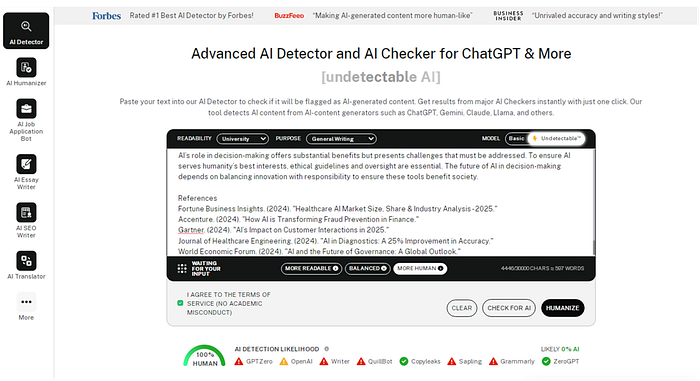
I used the same article as before, and it’s showing “0% AI.”
Let me purchase one of their packages to test out the advanced scan. Once you click on “Undetectable” right next to “Basic” on the screen (just above “CHECK FOR AI” and “HUMANIZE”), you’ll be prompted to sign up and select a plan.
You can use the advanced scan for free once you sign up.
I got the same results again.
Results
How to generate text using Undetectable AI
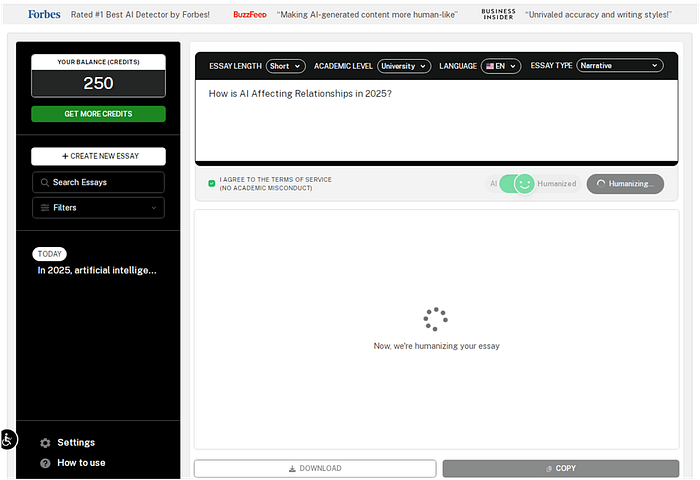
Next, I tried the AI Essay Writer. You can choose the length of your essay (short, medium, or long), select the academic level (high school, university, or doctorate), pick your language (there are 16 options), and choose your essay type (descriptive, narrative, expository, etc.). They also give you the option to make the essay sound humanized or simply AI-like.
I chose these options:
Length: Short
Academic Level: University
Language: English
Essay Type: Narrative
Humanize
After typing in my topic, I clicked on “Write My Essay.” For the free plan, you get 250 credits = 250 words.
What I noticed is that the AI Humanizer tool takes a lot of time to work on the free plan. To get quicker results, you’ll need to upgrade to one of their plans.
The AI Job Application Bot creates your resume and cover letters using AI, personalizes your job search, and auto-applies to jobs. It is easily integrable with LinkedIn. Pretty cool, right?
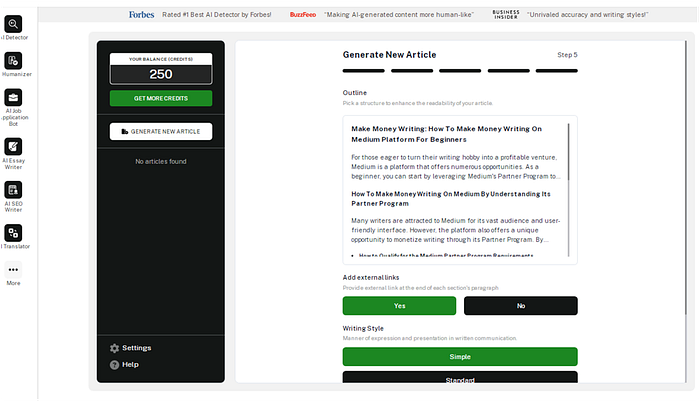
I tested the AI SEO Writer tool of Undetectable AI. You’re asked to fill in some basic information before the article is generated, such as your company website, product, target demographic, etc.
Then you’ll be prompted to choose from a list of SEO keywords and a title related to the theme of your article. You can also choose to add an AI-generated image and select its style.
For 1,000+ words, you need 6,000 credits.
For 2,000+ words, you need 9,000 credits.
For 4,000+ words, you need 12,000 credits.
You can pick an outline, add external links, and also choose your writing style.
Click on “Generate Article,” and you’ll get a nice, SEO-friendly article without having to do much.
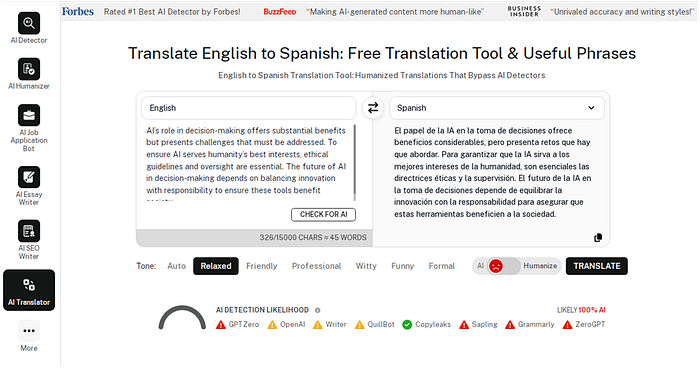
The AI Translator tool is pretty cool too. All you have to do is copy-paste the text, select the language, and that’s it! You get your translated text.
You can check for AI and humanize your text while translating. You can also choose the tone of the translated text — Relaxed, Funny, etc.
I used a paragraph from the previously used ChatGPT article, and it shows 100% AI. Well, it worked this time. So, that means their “AI Detector” tool does work. It just doesn’t work on the “AI Detector and Humanizer” page.
I used an existing prompt, and it gave pretty good information regarding Greek mythology. You can also humanize the answer if you want. That’s cool.
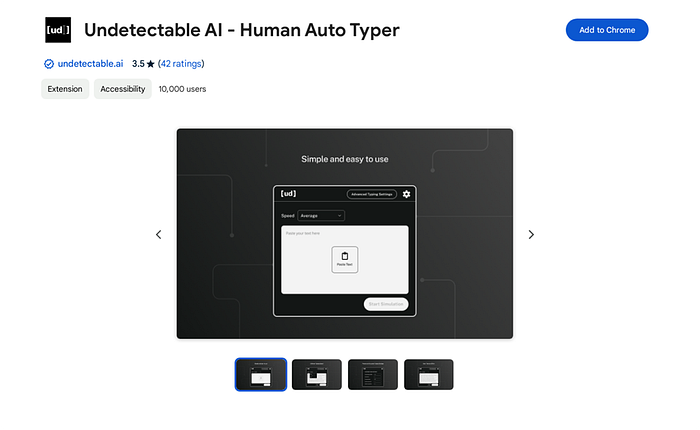
Undetectable AI has a “Human Typer” tool. To use this, you need to install the Chrome extension. Once installed, you can directly integrate the tool with Google Docs. What this tool does is simulate human-like typing, automatically typing out your pre-written content.
Next, I tested out the word counting tool. The results were pretty accurate:
What I liked best about this is how it automatically gives me a report on whether or not the text is AI-generated.
GPTZero claims to incorporate the latest research in detecting all types of AI LLMs.
This tool doesn’t just stop at AI detection. It can carry out an advanced AI scan, identify the most commonly used AI words, offer a plagiarism checker, authorship verification, and even a source finder.
You’ll find the AI detector tool right on their homepage.
Well, let’s put this tool to the test, shall we?
I asked ChatGPT to write a nice, human-like passage for me:
Let’s see whether GPTZero can detect if this text is AI-generated or not.
GPTZero also allows you to upload files — PDF, .doc, .docx, .txt, .jpg, .jpeg, .png, .gif, .webp — which is pretty cool. I copied and pasted this text into the AI detection tool space.
Now click on “Scan for AI”.
Results
Pricing
9. Originality.ai
Originality.ai claims to be one of the most accurate AI detectors.
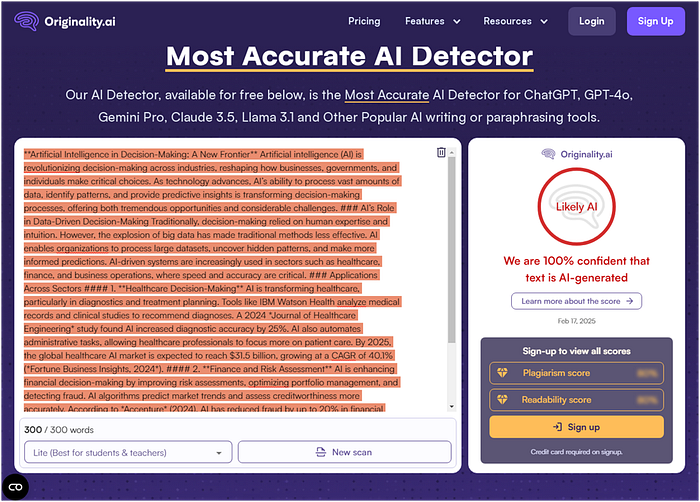
Yes, the AI detector tool definitely works. This text is purely AI-generated.
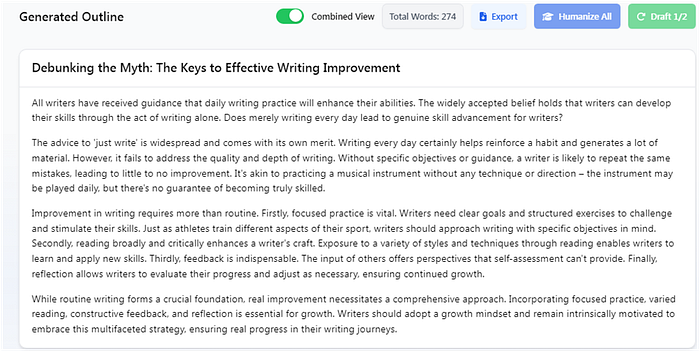
Next, let’s try the “Content Generator” tool. I need to enter a brief outline of my expectations for Phrasly.AI, mention the writing purpose (story, article, etc.), the language, and the word count (minimum 350 words, maximum 500 words).
After entering this information, I click on “Generate Outline.” The tool then provides me with a list of topics to choose from (I can select only two). Once I’ve shortlisted two, I click on “Confirm Topics.” You can also add your own custom topic.
Results
Pricing
Why Do You Need AI Detectors?
AI detectors are tools that help differentiate human-written content from generative AI-generated content. At first, I wasn’t sure how important AI detectors were.
After all, if generative AI can create content, surely it could create tools to spot it, too, right? So, what’s the big deal?
But after trying these detectors myself, I realized just how much of a game-changer they are.
With the way AI technology is advancing, it’s becoming harder to tell what’s human and what’s AI-generated.
On top of that, we can’t forget about deepfake scams, misinformation, and intellectual property violations.
That’s exactly where AI detectors come in.
AI detectors ensure that content creators get the credit they deserve, protect brand integrity, and also make sure academic authenticity is preserved.
How I Tested and Ranked the Best AI Detectors
I focused on a bunch of criteria to make sure my assessment was as nearly perfect as possible.
Accuracy
How accurately can the tool differentiate between human and AI-generated content?
Can the tool identify subtle patterns that distinguish human from AI?
Speed
How quickly can the tool analyze content?
Is the tool responsive even with larger files or more complex data?
Usability
How user-friendly is the interface?
Are there helpful features like tutorials or support?
Supported Formats (text, image, video)
Does the tool support multiple types of content?
How well does the tool handle each format?
Pricing & Value for Money
How affordable is the tool for the value it offers?
Is there flexibility in pricing plans?
Tips for Choosing the Right AI Detectors
Accuracy: Pick a tool that gets it right most of the time.
Clear Explanations: A good detector won’t just say “AI-generated”. It’ll tell you why it thinks so.
Up-to-Date: AI writing tools are getting better fast, so make sure you use the latest tool.
Choose One That Fits: Pick a tool based on your needs — bulk scans, browser extensions, API access, etc.
AI Detector Extensions & Integrations
AI Detector Extensions & Integrations: Incorporating AI detector extensions enhances workflow efficiency. Utilize the AI detection model Browser Extension for seamless detection within web browsers. Integrate AI detection tools with Google Docs for streamlined content evaluation. By leveraging these integrations, users can seamlessly access detection capabilities within their preferred platforms, ensuring a comprehensive approach to content evaluation. These integrations offer convenience and ease of use, facilitating enhanced AI detection processes across various content formats.
AI Detector Browser Extension
QuillBot is a versatile AI detection tool with advanced features. To detect AI text using QuillBot, input the text and analyze the results for accuracy. QuillBot offers a range of other AI tools and services within its suite. In terms of pricing, QuillBot provides competitive rates for its functionalities. QuillBot proves to be a comprehensive AI detection tool in the market, catering to various needs with its efficient solutions.
Use Google Docs with AI Detection
QuillBot offers a robust AI text detection feature with high accuracy in identifying generated content. Its suite includes other useful AI tools complementing the writing process and detection process. The pricing model is competitive, making it a cost-effective choice for users. When testing QuillBot, the results for AI text detection were impressive, showcasing its efficiency in uncovering plagiarized or AI-generated text. Additionally, the tool provides detailed reports for users to analyze.
I Tested 7 Tools, and Here are the Best AI Detectors of 2025 (Ranked and Reviewed): Final words
The good news? AI is here to stay for the long run.
The bad news? AI is here to stay for the long run.
So, instead of rejecting it altogether, it’s important you make the best use of it. AI won’t replace you. It’ll replace those who don’t know how to deploy it in their daily lives.
But it’s also important to preserve human creativity, and that’s why there’s a growing demand for AI detectors across industries.
So, which tool is the best? It depends on your needs.
QuillBot if you want a bunch of cool AI tools like Paraphraser, AI Detector, and AI Humanizer.
If you want an AI detector designed for education and authenticity verification, opt for Winston AI. It’s 99.98% accurate and super easy to use.
If you want an AI detector with a a Chrome extension that can be integrated with Google Classroom and Canvas, go for Pangram Labs.
For detecting AI on academic papers and school assignments, Proofademic seems to be the best option.
For AI detector, humanizer, and a bunch of other tools like paraphraser, proofreader, slogan generator, etc., go for Detecting-AI.
If you want your AI detector to double as your photo and video editing tool, along with a bunch of other cool features, opt for Monica.
If you need an AI detector that has a bunch of extra features like AI Humanzier, AI Job Application Bot, AI Essay Writer, etc., try Undetectable AI.
If you want an AI detector with a generous plan, go for GPTZero.
If you’re looking for a highly accurate AI and plagiarism detector, use Originality.ai.
If you’re looking to humanize AI-generated text for better readability and bypass detectors, use Phrasly.AI.
Start using these tools today to improve your writing while keeping it real and authentically you.
Frequently Asked Questions (FAQs) About AI Detectors
1. What Is an AI Detector?
An AI content detector is a tool that identifies whether a piece of text, image, or content has been generated by artificial intelligence (AI) models like ChatGPT, Gemini, or Bard. These tools analyze patterns, sentence structures, and probability scores to determine AI-generated content.
2. Which Is the Most Accurate AI Detector in 2025?
Based on my testing, Originality.ai and Winston AI are the most accurate AI detectors in 2025. They provide in-depth analysis, highlight AI-generated sections, and offer plagiarism detection.
3. Are AI Detectors 100% Reliable?
No, AI detectors using machine learning are not 100% accurate. Some human-written text may be falsely flagged as AI-generated (false positives), and some AI-generated content may bypass detection (false negatives). Accuracy varies based on the detector and its algorithm.
4. Can AI Detectors Be Tricked or Bypassed?
Yes, AI-generated text can be humanized using tools like Undetectable AI. These tools modify the text to make it seem more human-written, helping it bypass detection.
For full AI detection capabilities, most tools require a paid plan.
6. Do AI Detectors Work on Images and Videos?
Some AI detectors, like AI Detector, offer image analysis to determine if an image is AI-generated. Detecting AI-generated videos is still in early development.
7. Can AI Detectors Identify Plagiarism?
Not all AI detectors check for plagiarism, but Originality.ai and GPTZero offer both AI detection and plagiarism scanning, making them great choices for writers and educators.
8. Who Uses AI Detectors?
AI detectors are widely used by:
Educators & Universities — To check for AI-generated assignments.
Writers & Bloggers — To ensure their content is original.
SEO Experts — To maintain high-quality, human-written content.
Businesses — To prevent AI-generated misinformation.
9. What’s the Future of AI Detection?
As AI writing tools improve, AI detectors must evolve to stay ahead. Expect better accuracy, deepfake detection, and real-time AI verification tools in the coming years.
If you found this article useful, here’s another one you might enjoy:
Looking to Make Money With Side Hustles? These 3 AI Tools Can Help
3 cool side hustle ideas for creative entrepreneurs to make extra $$$$ on the side.
It’s changing the way we work, create, and interact online. Almost every post we see today has a high chance of being AI-generated.
The global AI market is projected to surpass $826 billion by 2030. AI-powered writing tools are growing at a 25% CAGR, and AI image generators are expanding at 17.5% CAGR through 2032.
Yes, AI makes life easier. It saves us time, money, and effort.
But are we all becoming increasingly dependent on AI?
Think about it.
Need gift ideas? Ask AI.
Don’t know the meaning of a word? Ask AI.
Don’t have the right opening sentence? Ask AI.
I’m sure everyone, from educators to policymakers, is guilty of this.
But they’re also turning to AI detection tools to protect against fraud.
In this article, I’ll break down 10 AI detection tools I’ve tested, along with why you should start using them in your daily routine.
Affiliate Disclosure: This post contains affiliate links. If you purchase through them, I may earn a small commission at no extra cost to you. I only recommend products I trust or use myself. Your support keeps my content journey going — thank you!
🙌 Additional author’s note: For some tools, I received complimentary access for review purposes, but all testing, reviews, and opinions are my own.
Best AI Detectors to Identify AI-Generated Content in 2025 (Reviewed & Ranked)
Let’s look at some AI detector tools you might want to consider.
1. QuillBot
QuillBot is one of the popular tools among writers as it is easy to use and gives accurate results.
This tool lets you detect AI-generated text, humanize text, correct Grammar, find citations, check Plagiarism, manage projects, and whatnot.
Let’s explore its AI Detector tool first.
How to detect AI text using QuillBot
Here’s how you can access the AI detector of QuillBot:
I purchased their premium plan to check all the tools.
If you want to purchase the premium plan or check the pricing, click on “QuillBot Premium” in the left panel. You can just tap on the “Upgrade” button to buy it.
I have pasted the same ChatGPT-generated text in QuillBot’s AI Detector.
The result shows 78% AI-generated — works well.
I am going to paste the same text in AI Humanizer and check its accuracy. In the left panel, go to “More” for more tools and select AI Humanizer.
QuillBot gives the Basic and Advanced modes for humanizing AI-generated content.
The resulting text sounds humane.
Let’s check whether the humanized text passes the AI Detector test or not.
I have copied and pasted the humanized text into the AI Detector.
Let’s see the results.
Nice! The QuillBot Humanizer beats its own AI Detector.
Why not try its AI Detector with actual human-written content?
Again, I am checking one of my articles, and hopefully it will be accurate.
As expected, 0% AI-generated text.
QuillBot’s AI Detector surpassed all my tests, and I am quite happy with both the free and premium versions. I am also going to add its extension now.
Other AI tools in the QuillBot suite
QuillBot provides a good collection of AI tools to enhance your content.
There are mainly eight tools:
Paraphrasing tool
Grammar Checker
Plagiarism Checker
AI Detector
AI Humanizer
Translate
Summarizer
Citation Generator
As you scroll down, there are different categories of cool tools for you to explore.
You can also get QuillBot’s extensions for Chrome, Word, Edge, or Safari. It’s free.
Or, you can download the QuillBot app for your mobile phone.
I liked the QuillBot Flow, basically a next-generation word-processor tool, to manage projects.
It also provides various templates like Literature Review, Appendix, Index, Harvard, Newsletter, Resume, Project Proposal, and many more.
These tools and templates can make writing easy for anyone.
Pricing
When it comes to pricing, QuillBot is quite affordable.
You can get the premium plan for just $4.17 per month, billed annually. QuillBot also offers a 3-day money-back guarantee in case you don’t want the premium plan.
QuillBot Premium allows unlimited paraphrasing, advanced Grammar recommendations, humanizes text in advanced mode, unlimited access to AI Detector, and many more features.
If you’re an entrepreneur, you can get the team plan for your organization.
The best thing is that you can pause your subscription anytime you want.
QuillBot’s AI Detector is accurate when it comes to AI detection. I am satisfied with the results and happy to include QuillBot in my collection of tools.
It’s easy to use, and the free version works well too. It has several tools to write flawlessly, like AI Detector, Plagiarism Checker, Humanizer, Word counter, Spell Checker, and others.
QuillBot is suitable for writers, students, teachers, employees, and those who want to write accurately and improve their writing skills.
2. Winston AI
Winston AI is the only AI detector with a 99.98% accuracy rate. This tool can be used by educational institutions, for SEO, and to improve your content’s authenticity.
Let’s use a sample text from Gemini this time. What I liked is that you can get a 14-day, 2,000-word scan trial for free, and you don’t need a credit card to sign up. This tool gives you a chance to test out the features for a decent amount of time before deciding whether to purchase it.
Results
Well, the tool works pretty well for a passage generated by Gemini.
You need to upgrade in order to use the Plagiarism detector tool or get writing feedback.
Let’s test this tool on one of my articles (100% human-written).
95% is a pretty good score when it comes to AI detectors.
How to detect AI images using Winston AI
Winston AI also has an “Image Scan” tool. Each scan costs 300 credits. I’m going to put this tool to the test using an image where one side contains a real selfie of mine, while the other has an AI-generated headshot. Let’s see if Winston AI can provide the right analysis.
Well, this is pretty interesting. I did edit the picture myself, so I guess Winston AI is correct in identifying the origin as human. Or perhaps the AI-generated headshot is so accurate that it’s evading detection by AI tools?
Winston AI also provides a certification — HUMN1 — to prove that the content on your blog is human-generated. You can integrate this with a WordPress plugin or use an XML sitemap.
Next, I’m testing out the “Text Compare” tool. Each comparison costs ¼ credits per word. On the left side, I’ve added a passage from my own article, and on the right, I’ve added the AI-generated version of the same passage.
Here’s what I got.
Only 5% similarity with the AI-generated version. That’s good news, right? This tool can help you analyze different writing styles, choose the best version, or even help you identify repeated sentences and words.
Winston AI can be easily integrated with Google Chrome, Zapier, Google Classroom, Microsoft Edge, and many others to make your work life much easier.
The “Free” plan has a ton of options to choose from. If you’d like to try out their other tools like AI writer and AI humanizer, the “Unlimited” plan is pretty affordable, at just $12.99 per month.
I’d say the AI detector, content generator, and humanizer work perfectly well. I’m pretty impressed, actually. For the level of accuracy this tool provides, I think the pricing is quite reasonable. Definitely Phrasly.AI is one of the best humanizers I’ve used so far.
3. Proofademic
Proofademic is an academic AI detector that instantly detects content written using ChatGPT, Gemini, and other AI tools.
This tool can be used to detect AI-generated text in academic essays, papers, and articles. Proofademic also offers multi-language support, including French, Spanish, and more.
As I mentioned earlier, once you’ve signed up, simply paste your content into the blank space under “New Document”. You can also upload a complete document for scanning.
I tested two passages generated by ChatGPT and Gemini, along with one passage from an article I originally wrote. What stood out immediately was the tool’s smooth UI. Pretty simple, hassle-free, and easy to navigate.
Results
Well, the generated article is fully AI-generated, and Phrasly.AI admits it. See the lines highlighted in red? That means those lines are AI-generated.
Let’s try and humanize it.
Well, that looks pretty clean. I know what to do next. Let’s test it out on GPTZero to see if it can actually bypass AI detectors.
It works! That’s amazing. The passage humanized by Phrasly.AI did bypass GPTZero’s AI detector. This is pretty cool, isn’t it?
Pricing
4. Pangram Labs
Pangram Labs claims that its AI detector is better than all other detectors out there in the market. This tool has been reviewed by the University of Maryland and has an impressive list of clients such as Quora, Featured, American Association for Cancer Research, and more.
The homepage looks pretty good. Maintains a nice balance between colors, spacing, and typography, and feels well-organized. For me, aesthetics and usability are equally important.
You can either paste your text or upload a file. I tested this tool using a passage generated by DeepSeek. You can also check for plagiarism simultaneously by clicking on “Check for plagiarism”.
The passage showed 100% AI but 0% plagiarism. That’s because it was a fictional passage generated.
Now, let’s try testing a passage from one of my articles.
No AI detected, which is absolutely correct. You can also share this generated report in public to gain credibility or download it.
The “AI Phrases Tool” points out all the phrases that are commonly used by AI. I used a passage generated by ChatGPT this time, and here’s what I got.
You can see that Pangram Labs has clearly highlighted the phrases most likely to be used by AI content generators or LLMs.
Pangram Labs also lets you compare texts side by side to spot similar phrases. For instance, I used a passage from one of my articles and asked ChatGPT to enhance it. Now, let’s compare the two. This cost me 1 credit.
This can be really useful if you’re confused about finding specific terms inside your long essays or research papers, and to check whether all the relevant keywords have been added or not.
Pangram Labs also has a Chrome extension and can be integrated with Google Classroom and Canvas.
What I also like about this tool is the detailed blogs mentioned on the dashboard. These blogs can help you understand how things work and give a perception of AI detection.
Pricing
5. Detecting-AI
Detecting-AI is a hub of tools required for content creation and analysis. It claims to identify AI-generated text by ChatGPT, Gemini, Jasper, Claude, and other similar models.
Let’s test its AI Detector and other tools.
How to detect AI text using Detecting AI
Here’s how to leverage this wonderful AI Detecting tool:
You’ll see the AI Detector tool right at the top of the homepage.
The best thing about this tool is that you can detect AI without signing in and for free.
Now let’s test if this free tool is really worth it. Later, we’ll explore its paid version as well.
I asked ChatGPT, which utilizes generative artificial intelligence, to write a short and human-like article for me:
Let’s check whether Detecting-AI can tell if this article is AI-generated or not.
You can just paste the text or upload the file in .txt, .doc, .docx, or PDF format. I copied the text from ChatGPT and pasted it into the blank space.
Note that you can upload up to 5000 characters and also change the model version from V1 to V2.
Now tap on “Detect AI”.
AI text detection results
Here are the results:
The free version marked this text as 95.2% AI generated — pretty accurate.
Apart from English, Detecting-AI supports many languages like French, Dutch, Russian, German, Portuguese, Spanish, and Arabic, using natural language processing capabilities for efficient detection.
Now let’s try to humanize this AI-written content.
Oh snap! For the free version, we can humanize up to 125 words at once.
Let’s add the first two paragraphs and see the results.
Sounds more human. Let me copy and paste the humanized text again in the AI detector for comparison with a large language model.
And this is what I got.
59.8% written by AI! It shows that this text was likely written by AI, which is true.
This free version passed my tests, and the results are pretty good so far.
Again, let’s paste this humanized text on GPTZero.
Great! It shows “Possible AI paraphrasing detected”. I am quite happy with the results of GPTZero.
It’s time to test Detecting-AI with actual human-written content. I am pasting one of my articles. FYI, it’s 100% human-generated.
Oops! This time it failed. It showed the text as 72.1% AI-written.
I purchased Detecting-AI‘s monthly plan to check the credibility of AI Detector and other tools.
If you want to purchase a plan, you can go to ‘Pricing’ at top of the homepage, select your desired plan, and click on ‘Get Started’. Then you can sign in using Gmail and make the payment.
Now let’s see how well AI Detector works in the paid version, especially with any new models.
I will paste an AI-generated text first (from ChatGPT).
You can select different tools to analyse your text, like AI Detecting, Readability, Plagiarism, and more.
Click on ‘Run Selected Scans’ and here we go.
The Analysis Result shows potentially AI (67%).
In the right panel, you can see the analysis results of your selected tools, such as Readability and Plagiarism, by clicking on different icons.
Let’s try its Humanizer tool and check the results again.
Tap on the Humanize Text in AI Content Analysis.
Now, click on Check For AI. Let’s see what it says.
Likely human-written with a 24% score. Nice!
I’d like to use a paragraph from one of my articles (100% human-written) and see if it works.
Well, not so satisfactory. It marked the text as 63% AI. This seems to be a pretty common problem in all AI detectors. A lot of human-written text is marked as AI. I wouldn’t worry so much about changing it, as long as it feels authentic to me.
APIs
Detecting-AI has plenty of useful API tools like AI Detector API, AI Humanizer API, and Plagiarism Checker API. Additionally, the AI writing detector feature can enhance your ability to assess the authenticity of content.
Based on your requirement, you can seamlessly integrate any API into your workflow. The AI Detector API can be handy for reviewing academic papers, social media posts, or blogs.
I’ve discussed the pricing for APIs in the later sections.
Other AI tools in the Detecting-AI suite
Detecting-AI provides a bunch of tools to analyse content, including an AI checker.
If you go to the ‘features’ on the homepage, you will find tools like AI Detector, Plagiarism Checker, Fact Checker, AI Humanizer, and Other AI Tools.
But if you want to use Fact Checker or Plagiarism Checker, you’ll need to upgrade your plans.
You’ll get plenty of AI tools to enhance your content and analyse it when you go to Other AI Tools.
Some of the cool tools are:
AI Text Detector
Sentence Rewriter
Plagiarism Detector
Paragraph Generator
Rewording Tool
Paragraph Rewriter
Fact Checker
These SEO tools are useful for content creators and those planning to become one.
Join Medium for free to get updates from this writer.
If you want to integrate API features, you can purchase individual features or get an All-in-one Bundle.
Based on the words per month, you can select the pricing for AI Detector, AI Humanize, and Plagiarism Checker APIs.
Or, you can get access to all features at a 10% discount in the All-in-one Bundle. You can also select the pricing based on words per month.
Detecting-AI works well in detecting AI-generated content, achieving an industry-low false positive rate. Although I didn’t see much difference in the free and paid version results.
It has several tools to help you in your content creation journey, like Grammar Checker, Podcast Name Generator, Slogan Generator, and many more.
If you’re a student, educator, blogger, researcher, or business owner, Detecting-AI can be helpful for you in many ways.
6. Monica
Monica is an all-in-one AI assistant built to improve your productivity. This tool provides personalized, fast, and free support. Monica makes use of LLMs like OpenAI o3-mini, GPT-4o, and more.
This tool lets you chat, search, and helps you with writing and coding tasks. You can also install the browser extension
Monica has an in-built writing tool, grammar checker, translator, AI detector, image and video generator, and so much more.
Let’s test out the features one by one, though my primary focus will be on Monica’s AI detector. I’ll start by experimenting with the chat feature.
How to generate text using Monica
If you’ve been using LLMs for a while, you probably know the pain of switching between different models to see which one gives the best results. If you looked at my laptop screen during research, you’d find at least 10 tabs open — ChatGPT, Gemini, Claude.ai, DeepSeek, and whatnot. It’s super frustrating.
But Monica makes it seamless. This tool integrates all the LLMs in one place. I no longer have to keep switching tabs or sign up multiple times just to compare results. I simply select the LLM I want to work with inside Monica and that’s it!
For example, I’m using the same prompt to generate a passage using both Monica‘s in-built LLM and DeepSeek R1.
You can also compare different models to see which one suits you best. That way, you no longer need to jump between tabs all the time.
Now, I’m going to test the “Write” feature of Monica. You can compose blogs, articles, Twitter posts, emails, and more, just by entering a text prompt. Here’s what I got:
Monica gives you the option to improve the text further using AI. Other than this, the tool has a “Reply” feature that generates responses on your behalf, along with a built-in grammar checker.
How to detect AI text using Monica
Now, I’m going to copy the generated text and paste it into Monica‘s “AI Detector”.
As you can see, Monica‘s AI detector has correctly identified that the text is AI-generated. Now, I’m going to test the humanizer to see how well it performs.
Will it be able to bypass its own AI detector? Let’s find out.
Results
How to generate AI images using Monica
Monica has an image generator tool, which generates images based on a text prompt. You can upscale an image, generate AI ID photos, create 4K wallpapers, remove watermarks, and do so much more.
I’m going for simple image generation based on a text prompt. I can choose multiple models, but I’m choosing ‘Stable Diffusion XL 1.0′. Style — ‘Realistic’, Aspect Ratio — ‘1:1′.
The image generated is really nice, but it didn’t follow my prompt to the tee. I still find this pretty amazing. When I asked ChatGPT to generate an image based on the same prompt, to be honest, I got far better results in terms of following my prompt.
I’m amazed at the clarity ChatGPT has with the text. Even just a couple of months ago, LLMs used to struggle with generating high-quality text.
Here’s another one generated by Monica in “Anime” style:
Monica‘s video tools let you convert text to video, turn still images into animations, add creative effects, and more. I tested the image-to-video tool, and here’s the result:
This looks so good, right? Could you have ever imagined, even a year ago, that AI tools would become this efficient and accurate? Yes, there’s still room for improvement, like my belly’s looking a bit too rounded, but just think of how much these tools will advance in the next 1–2 years! Will this be good or bad? Only time will tell.
Monica‘s ‘Mermaid’ feature lets you create detailed flow charts from a simple prompt. This tool also has a ‘Live Voice’ feature that automatically detects emotions and needs based on your voice.
I definitely recommend using Monica. It’s a one-stop destination for all your content creation needs. You can do your research, generate content, humanize it, detect AI, generate images and videos with cool effects, and so much more.
Pricing
7. Undetectable AI
Undetectable AI has been ranked as the best AI detector by Forbes.
This tool also offers:
AI Humanzier
AI Job Application Bot
AI Essay Writer
AI SEO Writer
AI Translator
AI Chatbot
Human Typer
Word Counter
How to detect AI text using Undetectable AI
That’s quite a lot of features. Let’s test these tools out, one by one.
I used the same article as before, and it’s showing “0% AI.”
Let me purchase one of their packages to test out the advanced scan. Once you click on “Undetectable” right next to “Basic” on the screen (just above “CHECK FOR AI” and “HUMANIZE”), you’ll be prompted to sign up and select a plan.
You can use the advanced scan for free once you sign up.
I got the same results again.
Results
How to generate text using Undetectable AI
Next, I tried the AI Essay Writer. You can choose the length of your essay (short, medium, or long), select the academic level (high school, university, or doctorate), pick your language (there are 16 options), and choose your essay type (descriptive, narrative, expository, etc.). They also give you the option to make the essay sound humanized or simply AI-like.
I chose these options:
Length: Short
Academic Level: University
Language: English
Essay Type: Narrative
Humanize
After typing in my topic, I clicked on “Write My Essay.” For the free plan, you get 250 credits = 250 words.
What I noticed is that the AI Humanizer tool takes a lot of time to work on the free plan. To get quicker results, you’ll need to upgrade to one of their plans.
The AI Job Application Bot creates your resume and cover letters using AI, personalizes your job search, and auto-applies to jobs. It is easily integrable with LinkedIn. Pretty cool, right?
I tested the AI SEO Writer tool of Undetectable AI. You’re asked to fill in some basic information before the article is generated, such as your company website, product, target demographic, etc.
Then you’ll be prompted to choose from a list of SEO keywords and a title related to the theme of your article. You can also choose to add an AI-generated image and select its style.
For 1,000+ words, you need 6,000 credits.
For 2,000+ words, you need 9,000 credits.
For 4,000+ words, you need 12,000 credits.
You can pick an outline, add external links, and also choose your writing style.
Click on “Generate Article,” and you’ll get a nice, SEO-friendly article without having to do much.
The AI Translator tool is pretty cool too. All you have to do is copy-paste the text, select the language, and that’s it! You get your translated text.
You can check for AI and humanize your text while translating. You can also choose the tone of the translated text — Relaxed, Funny, etc.
I used a paragraph from the previously used ChatGPT article, and it shows 100% AI. Well, it worked this time. So, that means their “AI Detector” tool does work. It just doesn’t work on the “AI Detector and Humanizer” page.
I used an existing prompt, and it gave pretty good information regarding Greek mythology. You can also humanize the answer if you want. That’s cool.
Undetectable AI has a “Human Typer” tool. To use this, you need to install the Chrome extension. Once installed, you can directly integrate the tool with Google Docs. What this tool does is simulate human-like typing, automatically typing out your pre-written content.
Next, I tested out the word counting tool. The results were pretty accurate:
What I liked best about this is how it automatically gives me a report on whether or not the text is AI-generated.
GPTZero claims to incorporate the latest research in detecting all types of AI LLMs.
This tool doesn’t just stop at AI detection. It can carry out an advanced AI scan, identify the most commonly used AI words, offer a plagiarism checker, authorship verification, and even a source finder.
You’ll find the AI detector tool right on their homepage.
Well, let’s put this tool to the test, shall we?
I asked ChatGPT to write a nice, human-like passage for me:
Let’s see whether GPTZero can detect if this text is AI-generated or not.
GPTZero also allows you to upload files — PDF, .doc, .docx, .txt, .jpg, .jpeg, .png, .gif, .webp — which is pretty cool. I copied and pasted this text into the AI detection tool space.
Now click on “Scan for AI”.
Results
Pricing
9. Originality.ai
Originality.ai claims to be one of the most accurate AI detectors.
Yes, the AI detector tool definitely works. This text is purely AI-generated.
Next, let’s try the “Content Generator” tool. I need to enter a brief outline of my expectations for Phrasly.AI, mention the writing purpose (story, article, etc.), the language, and the word count (minimum 350 words, maximum 500 words).
After entering this information, I click on “Generate Outline.” The tool then provides me with a list of topics to choose from (I can select only two). Once I’ve shortlisted two, I click on “Confirm Topics.” You can also add your own custom topic.
Results
Pricing
Why Do You Need AI Detectors?
AI detectors are tools that help differentiate human-written content from generative AI-generated content. At first, I wasn’t sure how important AI detectors were.
After all, if generative AI can create content, surely it could create tools to spot it, too, right? So, what’s the big deal?
But after trying these detectors myself, I realized just how much of a game-changer they are.
With the way AI technology is advancing, it’s becoming harder to tell what’s human and what’s AI-generated.
On top of that, we can’t forget about deepfake scams, misinformation, and intellectual property violations.
That’s exactly where AI detectors come in.
AI detectors ensure that content creators get the credit they deserve, protect brand integrity, and also make sure academic authenticity is preserved.
How I Tested and Ranked the Best AI Detectors
I focused on a bunch of criteria to make sure my assessment was as nearly perfect as possible.
Accuracy
How accurately can the tool differentiate between human and AI-generated content?
Can the tool identify subtle patterns that distinguish human from AI?
Speed
How quickly can the tool analyze content?
Is the tool responsive even with larger files or more complex data?
Usability
How user-friendly is the interface?
Are there helpful features like tutorials or support?
Supported Formats (text, image, video)
Does the tool support multiple types of content?
How well does the tool handle each format?
Pricing & Value for Money
How affordable is the tool for the value it offers?
Is there flexibility in pricing plans?
Tips for Choosing the Right AI Detectors
Accuracy: Pick a tool that gets it right most of the time.
Clear Explanations: A good detector won’t just say “AI-generated”. It’ll tell you why it thinks so.
Up-to-Date: AI writing tools are getting better fast, so make sure you use the latest tool.
Choose One That Fits: Pick a tool based on your needs — bulk scans, browser extensions, API access, etc.
AI Detector Extensions & Integrations
AI Detector Extensions & Integrations: Incorporating AI detector extensions enhances workflow efficiency. Utilize the AI detection model Browser Extension for seamless detection within web browsers. Integrate AI detection tools with Google Docs for streamlined content evaluation. By leveraging these integrations, users can seamlessly access detection capabilities within their preferred platforms, ensuring a comprehensive approach to content evaluation. These integrations offer convenience and ease of use, facilitating enhanced AI detection processes across various content formats.
AI Detector Browser Extension
QuillBot is a versatile AI detection tool with advanced features. To detect AI text using QuillBot, input the text and analyze the results for accuracy. QuillBot offers a range of other AI tools and services within its suite. In terms of pricing, QuillBot provides competitive rates for its functionalities. QuillBot proves to be a comprehensive AI detection tool in the market, catering to various needs with its efficient solutions.
Use Google Docs with AI Detection
QuillBot offers a robust AI text detection feature with high accuracy in identifying generated content. Its suite includes other useful AI tools complementing the writing process and detection process. The pricing model is competitive, making it a cost-effective choice for users. When testing QuillBot, the results for AI text detection were impressive, showcasing its efficiency in uncovering plagiarized or AI-generated text. Additionally, the tool provides detailed reports for users to analyze.
I Tested 7 Tools, and Here are the Best AI Detectors of 2025 (Ranked and Reviewed): Final words
The good news? AI is here to stay for the long run.
The bad news? AI is here to stay for the long run.
So, instead of rejecting it altogether, it’s important you make the best use of it. AI won’t replace you. It’ll replace those who don’t know how to deploy it in their daily lives.
But it’s also important to preserve human creativity, and that’s why there’s a growing demand for AI detectors across industries.
So, which tool is the best? It depends on your needs.
QuillBot if you want a bunch of cool AI tools like Paraphraser, AI Detector, and AI Humanizer.
If you want an AI detector designed for education and authenticity verification, opt for Winston AI. It’s 99.98% accurate and super easy to use.
If you want an AI detector with a a Chrome extension that can be integrated with Google Classroom and Canvas, go for Pangram Labs.
For detecting AI on academic papers and school assignments, Proofademic seems to be the best option.
For AI detector, humanizer, and a bunch of other tools like paraphraser, proofreader, slogan generator, etc., go for Detecting-AI.
If you want your AI detector to double as your photo and video editing tool, along with a bunch of other cool features, opt for Monica.
If you need an AI detector that has a bunch of extra features like AI Humanzier, AI Job Application Bot, AI Essay Writer, etc., try Undetectable AI.
If you want an AI detector with a generous plan, go for GPTZero.
If you’re looking for a highly accurate AI and plagiarism detector, use Originality.ai.
If you’re looking to humanize AI-generated text for better readability and bypass detectors, use Phrasly.AI.
Start using these tools today to improve your writing while keeping it real and authentically you.
Frequently Asked Questions (FAQs) About AI Detectors
1. What Is an AI Detector?
An AI content detector is a tool that identifies whether a piece of text, image, or content has been generated by artificial intelligence (AI) models like ChatGPT, Gemini, or Bard. These tools analyze patterns, sentence structures, and probability scores to determine AI-generated content.
2. Which Is the Most Accurate AI Detector in 2025?
Based on my testing, Originality.ai and Winston AI are the most accurate AI detectors in 2025. They provide in-depth analysis, highlight AI-generated sections, and offer plagiarism detection.
3. Are AI Detectors 100% Reliable?
No, AI detectors using machine learning are not 100% accurate. Some human-written text may be falsely flagged as AI-generated (false positives), and some AI-generated content may bypass detection (false negatives). Accuracy varies based on the detector and its algorithm.
4. Can AI Detectors Be Tricked or Bypassed?
Yes, AI-generated text can be humanized using tools like Undetectable AI. These tools modify the text to make it seem more human-written, helping it bypass detection.
For full AI detection capabilities, most tools require a paid plan.
6. Do AI Detectors Work on Images and Videos?
Some AI detectors, like AI Detector, offer image analysis to determine if an image is AI-generated. Detecting AI-generated videos is still in early development.
7. Can AI Detectors Identify Plagiarism?
Not all AI detectors check for plagiarism, but Originality.ai and GPTZero offer both AI detection and plagiarism scanning, making them great choices for writers and educators.
8. Who Uses AI Detectors?
AI detectors are widely used by:
Educators & Universities — To check for AI-generated assignments.
Writers & Bloggers — To ensure their content is original.
SEO Experts — To maintain high-quality, human-written content.
Businesses — To prevent AI-generated misinformation.
9. What’s the Future of AI Detection?
As AI writing tools improve, AI detectors must evolve to stay ahead. Expect better accuracy, deepfake detection, and real-time AI verification tools in the coming years.
If you found this article useful, here’s another one you might enjoy:
Looking to Make Money With Side Hustles? These 3 AI Tools Can Help
3 cool side hustle ideas for creative entrepreneurs to make extra $$$$ on the side.
It’s changing the way we work, create, and interact online. Almost every post we see today has a high chance of being AI-generated.
The global AI market is projected to surpass $826 billion by 2030. AI-powered writing tools are growing at a 25% CAGR, and AI image generators are expanding at 17.5% CAGR through 2032.
Yes, AI makes life easier. It saves us time, money, and effort.
But are we all becoming increasingly dependent on AI?
Think about it.
Need gift ideas? Ask AI.
Don’t know the meaning of a word? Ask AI.
Don’t have the right opening sentence? Ask AI.
I’m sure everyone, from educators to policymakers, is guilty of this.
But they’re also turning to AI detection tools to protect against fraud.
In this article, I’ll break down 10 AI detection tools I’ve tested, along with why you should start using them in your daily routine.
Affiliate Disclosure: This post contains affiliate links. If you purchase through them, I may earn a small commission at no extra cost to you. I only recommend products I trust or use myself. Your support keeps my content journey going — thank you!
🙌 Additional author’s note: For some tools, I received complimentary access for review purposes, but all testing, reviews, and opinions are my own.
Best AI Detectors to Identify AI-Generated Content in 2025 (Reviewed & Ranked)
Let’s look at some AI detector tools you might want to consider.
1. QuillBot
QuillBot is one of the popular tools among writers as it is easy to use and gives accurate results.
This tool lets you detect AI-generated text, humanize text, correct Grammar, find citations, check Plagiarism, manage projects, and whatnot.
Let’s explore its AI Detector tool first.
How to detect AI text using QuillBot
Here’s how you can access the AI detector of QuillBot:
I purchased their premium plan to check all the tools.
If you want to purchase the premium plan or check the pricing, click on “QuillBot Premium” in the left panel. You can just tap on the “Upgrade” button to buy it.
I have pasted the same ChatGPT-generated text in QuillBot’s AI Detector.
The result shows 78% AI-generated — works well.
I am going to paste the same text in AI Humanizer and check its accuracy. In the left panel, go to “More” for more tools and select AI Humanizer.
QuillBot gives the Basic and Advanced modes for humanizing AI-generated content.
The resulting text sounds humane.
Let’s check whether the humanized text passes the AI Detector test or not.
I have copied and pasted the humanized text into the AI Detector.
Let’s see the results.
Nice! The QuillBot Humanizer beats its own AI Detector.
Why not try its AI Detector with actual human-written content?
Again, I am checking one of my articles, and hopefully it will be accurate.
As expected, 0% AI-generated text.
QuillBot’s AI Detector surpassed all my tests, and I am quite happy with both the free and premium versions. I am also going to add its extension now.
Other AI tools in the QuillBot suite
QuillBot provides a good collection of AI tools to enhance your content.
There are mainly eight tools:
Paraphrasing tool
Grammar Checker
Plagiarism Checker
AI Detector
AI Humanizer
Translate
Summarizer
Citation Generator
As you scroll down, there are different categories of cool tools for you to explore.
You can also get QuillBot’s extensions for Chrome, Word, Edge, or Safari. It’s free.
Or, you can download the QuillBot app for your mobile phone.
I liked the QuillBot Flow, basically a next-generation word-processor tool, to manage projects.
It also provides various templates like Literature Review, Appendix, Index, Harvard, Newsletter, Resume, Project Proposal, and many more.
These tools and templates can make writing easy for anyone.
Pricing
When it comes to pricing, QuillBot is quite affordable.
You can get the premium plan for just $4.17 per month, billed annually. QuillBot also offers a 3-day money-back guarantee in case you don’t want the premium plan.
QuillBot Premium allows unlimited paraphrasing, advanced Grammar recommendations, humanizes text in advanced mode, unlimited access to AI Detector, and many more features.
If you’re an entrepreneur, you can get the team plan for your organization.
The best thing is that you can pause your subscription anytime you want.
QuillBot’s AI Detector is accurate when it comes to AI detection. I am satisfied with the results and happy to include QuillBot in my collection of tools.
It’s easy to use, and the free version works well too. It has several tools to write flawlessly, like AI Detector, Plagiarism Checker, Humanizer, Word counter, Spell Checker, and others.
QuillBot is suitable for writers, students, teachers, employees, and those who want to write accurately and improve their writing skills.
2. Winston AI
Winston AI is the only AI detector with a 99.98% accuracy rate. This tool can be used by educational institutions, for SEO, and to improve your content’s authenticity.
Let’s use a sample text from Gemini this time. What I liked is that you can get a 14-day, 2,000-word scan trial for free, and you don’t need a credit card to sign up. This tool gives you a chance to test out the features for a decent amount of time before deciding whether to purchase it.
Results
Well, the tool works pretty well for a passage generated by Gemini.
You need to upgrade in order to use the Plagiarism detector tool or get writing feedback.
Let’s test this tool on one of my articles (100% human-written).
95% is a pretty good score when it comes to AI detectors.
How to detect AI images using Winston AI
Winston AI also has an “Image Scan” tool. Each scan costs 300 credits. I’m going to put this tool to the test using an image where one side contains a real selfie of mine, while the other has an AI-generated headshot. Let’s see if Winston AI can provide the right analysis.
Well, this is pretty interesting. I did edit the picture myself, so I guess Winston AI is correct in identifying the origin as human. Or perhaps the AI-generated headshot is so accurate that it’s evading detection by AI tools?
Winston AI also provides a certification — HUMN1 — to prove that the content on your blog is human-generated. You can integrate this with a WordPress plugin or use an XML sitemap.
Next, I’m testing out the “Text Compare” tool. Each comparison costs ¼ credits per word. On the left side, I’ve added a passage from my own article, and on the right, I’ve added the AI-generated version of the same passage.
Here’s what I got.
Only 5% similarity with the AI-generated version. That’s good news, right? This tool can help you analyze different writing styles, choose the best version, or even help you identify repeated sentences and words.
Winston AI can be easily integrated with Google Chrome, Zapier, Google Classroom, Microsoft Edge, and many others to make your work life much easier.
The “Free” plan has a ton of options to choose from. If you’d like to try out their other tools like AI writer and AI humanizer, the “Unlimited” plan is pretty affordable, at just $12.99 per month.
I’d say the AI detector, content generator, and humanizer work perfectly well. I’m pretty impressed, actually. For the level of accuracy this tool provides, I think the pricing is quite reasonable. Definitely Phrasly.AI is one of the best humanizers I’ve used so far.
3. Proofademic
Proofademic is an academic AI detector that instantly detects content written using ChatGPT, Gemini, and other AI tools.
This tool can be used to detect AI-generated text in academic essays, papers, and articles. Proofademic also offers multi-language support, including French, Spanish, and more.
As I mentioned earlier, once you’ve signed up, simply paste your content into the blank space under “New Document”. You can also upload a complete document for scanning.
I tested two passages generated by ChatGPT and Gemini, along with one passage from an article I originally wrote. What stood out immediately was the tool’s smooth UI. Pretty simple, hassle-free, and easy to navigate.
Results
Well, the generated article is fully AI-generated, and Phrasly.AI admits it. See the lines highlighted in red? That means those lines are AI-generated.
Let’s try and humanize it.
Well, that looks pretty clean. I know what to do next. Let’s test it out on GPTZero to see if it can actually bypass AI detectors.
It works! That’s amazing. The passage humanized by Phrasly.AI did bypass GPTZero’s AI detector. This is pretty cool, isn’t it?
Pricing
4. Pangram Labs
Pangram Labs claims that its AI detector is better than all other detectors out there in the market. This tool has been reviewed by the University of Maryland and has an impressive list of clients such as Quora, Featured, American Association for Cancer Research, and more.
The homepage looks pretty good. Maintains a nice balance between colors, spacing, and typography, and feels well-organized. For me, aesthetics and usability are equally important.
You can either paste your text or upload a file. I tested this tool using a passage generated by DeepSeek. You can also check for plagiarism simultaneously by clicking on “Check for plagiarism”.
The passage showed 100% AI but 0% plagiarism. That’s because it was a fictional passage generated.
Now, let’s try testing a passage from one of my articles.
No AI detected, which is absolutely correct. You can also share this generated report in public to gain credibility or download it.
The “AI Phrases Tool” points out all the phrases that are commonly used by AI. I used a passage generated by ChatGPT this time, and here’s what I got.
You can see that Pangram Labs has clearly highlighted the phrases most likely to be used by AI content generators or LLMs.
Pangram Labs also lets you compare texts side by side to spot similar phrases. For instance, I used a passage from one of my articles and asked ChatGPT to enhance it. Now, let’s compare the two. This cost me 1 credit.
This can be really useful if you’re confused about finding specific terms inside your long essays or research papers, and to check whether all the relevant keywords have been added or not.
Pangram Labs also has a Chrome extension and can be integrated with Google Classroom and Canvas.
What I also like about this tool is the detailed blogs mentioned on the dashboard. These blogs can help you understand how things work and give a perception of AI detection.
Pricing
5. Detecting-AI
Detecting-AI is a hub of tools required for content creation and analysis. It claims to identify AI-generated text by ChatGPT, Gemini, Jasper, Claude, and other similar models.
Let’s test its AI Detector and other tools.
How to detect AI text using Detecting AI
Here’s how to leverage this wonderful AI Detecting tool:
You’ll see the AI Detector tool right at the top of the homepage.
The best thing about this tool is that you can detect AI without signing in and for free.
Now let’s test if this free tool is really worth it. Later, we’ll explore its paid version as well.
I asked ChatGPT to write a short and human-like article for me:
Let’s check whether Detecting-AI can tell if this article, generated with the help of generative artificial intelligence, is AI-generated or not.
You can just paste the text or upload the file in .txt, .doc, .docx, or PDF format. I copied the text from ChatGPT and pasted it into the blank space.
Note that you can upload up to 5000 characters and also change the model version from V1 to V2.
Now tap on “Detect AI”.
AI text detection results
Here are the results:
The free version marked this text as 95.2% AI generated — pretty accurate, contributing to a low false positive rate.
Apart from English, Detecting-AI supports many languages like French, Dutch, Russian, German, Portuguese, Spanish, and Arabic.
Now let’s try to humanize this AI-written content.
Oh snap! For the free version, we can humanize up to 125 words at once.
Let’s add the first two paragraphs and see the results.
Sounds more human. Let me copy and paste the humanized text again in the AI detector.
And this is what I got.
59.8% written by AI! It shows that this text was likely written by AI, which is true.
This free version passed my tests, and the results are pretty good so far.
Again, let’s paste this humanized text on GPTZero.
Great! It shows “Possible AI paraphrasing detected”. I am quite happy with the results of GPTZero.
It’s time to test Detecting-AI with actual human-written content. I am pasting one of my articles. FYI, it’s 100% human-generated.
Oops! This time it failed. It showed the text as 72.1% AI-written.
I purchased Detecting-AI‘s monthly plan to check the credibility of AI Detector and other tools.
If you want to purchase a plan, you can go to ‘Pricing’ at top of the homepage, select your desired plan, and click on ‘Get Started’. Then you can sign in using Gmail and make the payment.
Now let’s see how well AI Detector works in the paid version, along with its support for detecting new models.
I will paste an AI-generated text first (from ChatGPT).
You can select different tools to analyse your text, like AI Detecting, Readability, Plagiarism, and more.
Click on ‘Run Selected Scans’ and here we go.
The Analysis Result shows potentially AI (67%).
In the right panel, you can see the analysis results of your selected tools, such as Readability and Plagiarism, by clicking on different icons.
Let’s try its Humanizer tool and check the results again.
Tap on the Humanize Text in AI Content Analysis.
Now, click on Check For AI. Let’s see what it says.
Likely human-written with a 24% score. Nice!
I’d like to use a paragraph from one of my articles (100% human-written) and see if it works.
Well, not so satisfactory. It marked the text as 63% AI. This seems to be a pretty common problem in all AI detectors. A lot of human-written text is marked as AI. I wouldn’t worry so much about changing it, as long as it feels authentic to me.
APIs
Detecting-AI has plenty of useful API tools like AI Detector API, AI Humanizer API, and Plagiarism Checker API.
Based on your requirement, you can seamlessly integrate any API into your workflow. The AI Detector API can be handy for reviewing academic papers, social media posts, or blogs.
I’ve discussed the pricing for APIs in the later sections.
Other AI tools in the Detecting-AI suite
Detecting-AI provides a bunch of tools to analyse content, including an AI checker.
If you go to the ‘features’ on the homepage, you will find tools like AI Detector, Plagiarism Checker, Fact Checker, AI Humanizer, and Other AI Tools.
But if you want to use Fact Checker or Plagiarism Checker, you’ll need to upgrade your plans.
You’ll get plenty of AI tools to enhance your content and analyse it when you go to Other AI Tools.
Some of the cool tools are:
AI Text Detector
Sentence Rewriter
Plagiarism Detector
Paragraph Generator
Rewording Tool
Paragraph Rewriter
Fact Checker
These SEO tools are useful for content creators and those planning to become one.
Join Medium for free to get updates from this writer.
If you want to integrate API features, you can purchase individual features or get an All-in-one Bundle.
Based on the words per month, you can select the pricing for AI Detector, AI Humanize, and Plagiarism Checker APIs.
Or, you can get access to all features at a 10% discount in the All-in-one Bundle. You can also select the pricing based on words per month.
Detecting-AI works well in detecting AI-generated content. Although I didn’t see much difference in the free and paid version results.
It has several tools to help you in your content creation journey, like Grammar Checker, Podcast Name Generator, Slogan Generator, and many more.
If you’re a student, educator, blogger, researcher, or business owner, Detecting-AI can be helpful for you in many ways.
6. Monica
Monica is an all-in-one AI assistant built to improve your productivity. This tool provides personalized, fast, and free support. Monica makes use of LLMs like OpenAI o3-mini, GPT-4o, and more.
This tool lets you chat, search, and helps you with writing and coding tasks. You can also install the browser extension
Monica has an in-built writing tool, grammar checker, translator, AI detector, image and video generator, and so much more.
Let’s test out the features one by one, though my primary focus will be on Monica’s AI detector. I’ll start by experimenting with the chat feature.
How to generate text using Monica
If you’ve been using LLMs for a while, you probably know the pain of switching between different models to see which one gives the best results. If you looked at my laptop screen during research, you’d find at least 10 tabs open — ChatGPT, Gemini, Claude.ai, DeepSeek, and whatnot. It’s super frustrating.
But Monica makes it seamless. This tool integrates all the LLMs in one place. I no longer have to keep switching tabs or sign up multiple times just to compare results. I simply select the LLM I want to work with inside Monica and that’s it!
For example, I’m using the same prompt to generate a passage using both Monica‘s in-built LLM and DeepSeek R1.
You can also compare different models to see which one suits you best. That way, you no longer need to jump between tabs all the time.
Now, I’m going to test the “Write” feature of Monica. You can compose blogs, articles, Twitter posts, emails, and more, just by entering a text prompt. Here’s what I got:
Monica gives you the option to improve the text further using AI. Other than this, the tool has a “Reply” feature that generates responses on your behalf, along with a built-in grammar checker.
How to detect AI text using Monica
Now, I’m going to copy the generated text and paste it into Monica‘s “AI Detector”.
As you can see, Monica‘s AI detector has correctly identified that the text is AI-generated. Now, I’m going to test the humanizer to see how well it performs.
Will it be able to bypass its own AI detector? Let’s find out.
Results
How to generate AI images using Monica
Monica has an image generator tool, which generates images based on a text prompt. You can upscale an image, generate AI ID photos, create 4K wallpapers, remove watermarks, and do so much more.
I’m going for simple image generation based on a text prompt. I can choose multiple models, but I’m choosing ‘Stable Diffusion XL 1.0′. Style — ‘Realistic’, Aspect Ratio — ‘1:1′.
The image generated is really nice, but it didn’t follow my prompt to the tee. I still find this pretty amazing. When I asked ChatGPT to generate an image based on the same prompt, to be honest, I got far better results in terms of following my prompt.
I’m amazed at the clarity ChatGPT has with the text. Even just a couple of months ago, LLMs used to struggle with generating high-quality text.
Here’s another one generated by Monica in “Anime” style:
Monica‘s video tools let you convert text to video, turn still images into animations, add creative effects, and more. I tested the image-to-video tool, and here’s the result:
This looks so good, right? Could you have ever imagined, even a year ago, that AI tools would become this efficient and accurate? Yes, there’s still room for improvement, like my belly’s looking a bit too rounded, but just think of how much these tools will advance in the next 1–2 years! Will this be good or bad? Only time will tell.
Monica‘s ‘Mermaid’ feature lets you create detailed flow charts from a simple prompt. This tool also has a ‘Live Voice’ feature that automatically detects emotions and needs based on your voice.
I definitely recommend using Monica. It’s a one-stop destination for all your content creation needs. You can do your research, generate content, humanize it, detect AI, generate images and videos with cool effects, and so much more.
Pricing
7. Undetectable AI
Undetectable AI has been ranked as the best AI detector by Forbes.
This tool also offers:
AI Humanzier
AI Job Application Bot
AI Essay Writer
AI SEO Writer
AI Translator
AI Chatbot
Human Typer
Word Counter
How to detect AI text using Undetectable AI
That’s quite a lot of features. Let’s test these tools out, one by one.
I used the same article as before, and it’s showing “0% AI.”
Let me purchase one of their packages to test out the advanced scan. Once you click on “Undetectable” right next to “Basic” on the screen (just above “CHECK FOR AI” and “HUMANIZE”), you’ll be prompted to sign up and select a plan.
You can use the advanced scan for free once you sign up.
I got the same results again.
Results
How to generate text using Undetectable AI
Next, I tried the AI Essay Writer. You can choose the length of your essay (short, medium, or long), select the academic level (high school, university, or doctorate), pick your language (there are 16 options), and choose your essay type (descriptive, narrative, expository, etc.). They also give you the option to make the essay sound humanized or simply AI-like.
I chose these options:
Length: Short
Academic Level: University
Language: English
Essay Type: Narrative
Humanize
After typing in my topic, I clicked on “Write My Essay.” For the free plan, you get 250 credits = 250 words.
What I noticed is that the AI Humanizer tool takes a lot of time to work on the free plan. To get quicker results, you’ll need to upgrade to one of their plans.
The AI Job Application Bot creates your resume and cover letters using AI, personalizes your job search, and auto-applies to jobs. It is easily integrable with LinkedIn. Pretty cool, right?
I tested the AI SEO Writer tool of Undetectable AI. You’re asked to fill in some basic information before the article is generated, such as your company website, product, target demographic, etc.
Then you’ll be prompted to choose from a list of SEO keywords and a title related to the theme of your article. You can also choose to add an AI-generated image and select its style.
For 1,000+ words, you need 6,000 credits.
For 2,000+ words, you need 9,000 credits.
For 4,000+ words, you need 12,000 credits.
You can pick an outline, add external links, and also choose your writing style.
Click on “Generate Article,” and you’ll get a nice, SEO-friendly article without having to do much.
The AI Translator tool is pretty cool too. All you have to do is copy-paste the text, select the language, and that’s it! You get your translated text.
You can check for AI and humanize your text while translating. You can also choose the tone of the translated text — Relaxed, Funny, etc.
I used a paragraph from the previously used ChatGPT article, and it shows 100% AI. Well, it worked this time. So, that means their “AI Detector” tool does work. It just doesn’t work on the “AI Detector and Humanizer” page.
I used an existing prompt, and it gave pretty good information regarding Greek mythology. You can also humanize the answer if you want. That’s cool.
Undetectable AI has a “Human Typer” tool. To use this, you need to install the Chrome extension. Once installed, you can directly integrate the tool with Google Docs. What this tool does is simulate human-like typing, automatically typing out your pre-written content.
Next, I tested out the word counting tool. The results were pretty accurate:
What I liked best about this is how it automatically gives me a report on whether or not the text is AI-generated.
GPTZero claims to incorporate the latest research in detecting all types of AI LLMs.
This tool doesn’t just stop at AI detection. It can carry out an advanced AI scan, identify the most commonly used AI words, offer a plagiarism checker, authorship verification, and even a source finder.
You’ll find the AI detector tool right on their homepage.
Well, let’s put this tool to the test, shall we?
I asked ChatGPT to write a nice, human-like passage for me:
Let’s see whether GPTZero can detect if this text is AI-generated or not.
GPTZero also allows you to upload files — PDF, .doc, .docx, .txt, .jpg, .jpeg, .png, .gif, .webp — which is pretty cool. I copied and pasted this text into the AI detection tool space.
Now click on “Scan for AI”.
Results
Pricing
9. Originality.ai
Originality.ai claims to be one of the most accurate AI detectors.
Yes, the AI detector tool definitely works. This text is purely AI-generated.
Next, let’s try the “Content Generator” tool. I need to enter a brief outline of my expectations for Phrasly.AI, mention the writing purpose (story, article, etc.), the language, and the word count (minimum 350 words, maximum 500 words).
After entering this information, I click on “Generate Outline.” The tool then provides me with a list of topics to choose from (I can select only two). Once I’ve shortlisted two, I click on “Confirm Topics.” You can also add your own custom topic.
Results
Pricing
Why Do You Need AI Detectors?
AI detectors are tools that help differentiate human-written content from generative AI-generated content. At first, I wasn’t sure how important AI detectors were.
After all, if generative AI can create content, surely it could create tools to spot it, too, right? So, what’s the big deal?
But after trying these detectors myself, I realized just how much of a game-changer they are.
With the way AI technology is advancing, it’s becoming harder to tell what’s human and what’s AI-generated.
On top of that, we can’t forget about deepfake scams, misinformation, and intellectual property violations.
That’s exactly where AI detectors come in.
AI detectors ensure that content creators get the credit they deserve, protect brand integrity, and also make sure academic authenticity is preserved.
How I Tested and Ranked the Best AI Detectors
I focused on a bunch of criteria to make sure my assessment was as nearly perfect as possible.
Accuracy
How accurately can the tool differentiate between human and AI-generated content?
Can the tool identify subtle patterns that distinguish human from AI?
Speed
How quickly can the tool analyze content?
Is the tool responsive even with larger files or more complex data?
Usability
How user-friendly is the interface?
Are there helpful features like tutorials or support?
Supported Formats (text, image, video)
Does the tool support multiple types of content?
How well does the tool handle each format?
Pricing & Value for Money
How affordable is the tool for the value it offers?
Is there flexibility in pricing plans?
Tips for Choosing the Right AI Detectors
Accuracy: Pick a tool that gets it right most of the time.
Clear Explanations: A good detector won’t just say “AI-generated”. It’ll tell you why it thinks so.
Up-to-Date: AI writing tools are getting better fast, so make sure you use the latest tool.
Choose One That Fits: Pick a tool based on your needs — bulk scans, browser extensions, API access, etc.
AI Detector Extensions & Integrations
AI Detector tools have evolved to incorporate AI content detector extensions and integrations that enhance their usability and effectiveness. One of the most popular options is the AI Detector browser extension. This extension allows for real-time detection of AI-generated content while you work on various platforms, such as Google Docs, online editors, and even social media sites. By integrating seamlessly into your existing workflow, users can quickly identify AI-generated text without interrupting their creative process. Many extensions also offer features like one-click scanning and quick comparisons between human and AI writing, making them a valuable asset for writers and educators alike.
Another significant integration is with Learning Management Systems (LMS). AI Detectors can be embedded into platforms like Canvas and Moodle, providing educators with a powerful tool to ensure academic integrity. This integration allows educators to easily assess student submissions for AI-generated content and analyze detailed reports, safeguarding originality in academic work. With these extensions and integrations, AI Detectors not only streamline the content creation process but also ensure that quality and authenticity remain at the forefront.
AI Detector Browser Extension
Using an AI Detector browser extension can significantly enhance your ability to maintain content authenticity while content writing. Once installed, these extensions provide real-time feedback on the text being generated, flagging any sections that may appear to be AI-written. This immediate analysis helps users adjust their writing on the fly, ensuring that the final output is not only coherent but also distinctly human. The convenience of having such a tool at your fingertips means that content creators can focus on their message without the constant concern of AI influence.
Moreover, many of these extensions come with added functionalities, such as grammar checks and readability assessments. These features contribute to an overall higher quality of writing by guiding users toward more effective communication. By integrating an AI Detector extension into your workflow, you can create content with confidence, knowing that your writing will stand out as genuine and original.
LMS AI Detector Integration
Integrating AI Detectors into Learning Management Systems (LMS) offers a robust solution for addressing academic integrity in educational settings. This integration enables educators to automatically scan student submissions for AI-generated content, helping to uphold the standards of originality in academic work. By using AI Detector tools and leveraging machine learning within platforms such as Canvas or Moodle, instructors can quickly assess the authenticity of assignments, making it easier to identify potential misuse of AI technologies.
Additionally, LMS integration allows for seamless tracking of student submissions over time, providing valuable insights into writing patterns and trends. This data can inform teaching strategies and help educators guide students toward developing their own writing skills. By fostering an environment where AI usage is monitored, educational institutions can encourage responsible AI use while ensuring that academic integrity remains intact.
I Tested 7 Tools, and Here are the Best AI Detectors of 2025 (Ranked and Reviewed): Final words
The good news? AI is here to stay for the long run.
The bad news? AI is here to stay for the long run.
So, instead of rejecting it altogether, it’s important you make the best use of it. AI won’t replace you. It’ll replace those who don’t know how to deploy it in their daily lives.
But it’s also important to preserve human creativity, and that’s why there’s a growing demand for AI detectors across industries.
So, which tool is the best? It depends on your needs.
QuillBot if you want a bunch of cool AI tools like Paraphraser, AI Detector, and AI Humanizer.
If you want an AI detector designed for education and authenticity verification, opt for Winston AI. It’s 99.98% accurate and super easy to use.
If you want an AI detector with a a Chrome extension that can be integrated with Google Classroom and Canvas, go for Pangram Labs.
For detecting AI on academic papers and school assignments, Proofademic seems to be the best option.
For AI detector, humanizer, and a bunch of other tools like paraphraser, proofreader, slogan generator, etc., go for Detecting-AI.
If you want your AI detector to double as your photo and video editing tool, along with a bunch of other cool features, opt for Monica.
If you need an AI detector that has a bunch of extra features like AI Humanzier, AI Job Application Bot, AI Essay Writer, etc., try Undetectable AI.
If you want an AI detector with a generous plan, go for GPTZero.
If you’re looking for a highly accurate AI and plagiarism detector, use Originality.ai.
If you’re looking to humanize AI-generated text for better readability and bypass detectors, use Phrasly.AI.
Start using these tools today to improve your writing while keeping it real and authentically you.
Frequently Asked Questions (FAQs) About AI Detectors
1. What Is an AI Detector?
An AI detector, specifically a chat gpt detector, is a tool that identifies whether a piece of text, image, or content has been generated by artificial intelligence (AI) models like ChatGPT, Gemini, or Bard. These tools analyze patterns, sentence structures, and probability scores to determine AI-generated content.
2. Which Is the Most Accurate AI Detector in 2025?
Based on my testing, Originality.ai and Winston AI are the most accurate AI detectors in 2025. They provide in-depth analysis, highlight AI-generated sections, and offer plagiarism detection.
3. Are AI Detectors 100% Reliable?
No, AI detectors are not 100% accurate. Some human-written text may be falsely flagged as AI-generated (false positives), and some AI-generated content, including output from a large language model, may bypass detection (false negatives). Accuracy varies based on the detector and its algorithm.
4. Can AI Detectors Be Tricked or Bypassed?
Yes, AI-generated text can be humanized using tools like Undetectable AI. These tools modify the text to make it seem more human-written, helping it bypass detection.
For full AI detection capabilities, most tools require a paid plan.
6. Do AI Detectors Work on Images and Videos?
Some AI detectors, like AI Detector, offer image analysis to determine if an image is AI-generated. Detecting AI-generated videos is still in early development.
7. Can AI Detectors Identify Plagiarism?
Not all AI detectors check for plagiarism, but Originality.ai and GPTZero offer both AI detection and plagiarism scanning, making them great choices for writers and educators.
8. Who Uses AI Detectors?
AI detectors are widely used by:
Educators & Universities — To check for AI-generated assignments.
Writers & Bloggers — To ensure their content is original.
SEO Experts — To maintain high-quality, human-written content.
Businesses — To prevent AI-generated misinformation.
9. What’s the Future of AI Detection?
As AI writing tools improve, AI detectors must evolve to stay ahead. Expect better accuracy, deepfake detection, and real-time AI verification tools in the coming years.
If you found this article useful, here’s another one you might enjoy:
Use The AI Detector Across Multiple Languages
If you’re looking to ensure accurate content analysis across various languages, using an AI detection model that supports multilingual capabilities is essential. These specialized tools leverage advanced machine learning algorithms to detect discrepancies in text across different languages, providing a comprehensive solution for content evaluation. By utilizing an AI detector that can effectively process and analyze text in multiple languages, you can enhance the accuracy and efficiency of your content detection process, making it easier to identify inconsistencies or potential issues in a diverse range of linguistic contexts.
Looking to Make Money With Side Hustles? These 3 AI Tools Can Help
3 cool side hustle ideas for creative entrepreneurs to make extra $$$$ on the side.
Here is a quick guide to healthy eating and what we will cover. Making smart food choices helps you feel good and stay healthy.
A balanced diet means eating many different foods from all the main food groups in the right amounts.
To focus on good nutrition, include lots of fruits, vegetables, and whole grains like brown rice and oats in your meals.
Lean proteins such as poultry and fish, along with plant-based foods like beans and lentils, are important for your body to grow and heal.
Choosing unsaturated fats from foods like olive oil and nuts helps lower cholesterol and keeps your heart healthy.
Knowing how to read food labels helps you find hidden sugars and make healthier choices at the shop.
Try to eat at least five portions of fruit and vegetables every day to lower the chance of serious health problems.
Introduction
Starting a journey towards healthy eating is one of the best things you can do for your overall health. It is not about strict diets but about enjoying a range of nutritious foods that give your body what it needs to stay strong. Good nutrition has many health benefits. It can increase your energy and lower the risk of heart disease. By learning about different dietary patterns and the best foods to include in a healthy diet, you can make simple changes that help you become healthier and happier. This guide will help you create a balanced diet full of tasty and wholesome foods, making healthy eating a part of your life that lasts.
The Ultimate Guide to Healthy Food Choices: Essential Foods for Every Kitchen
To make healthy eating easier, it is good to keep your kitchen stocked with the right foods. When you have healthy options ready, you are more likely to choose them, even when your day is busy. Think of your kitchen as the base of your health. If it has a variety of fruit, a variety of vegetables, and other good foods, you are set for success.
Following general dietary guidelines helps you get all the important nutrients your body needs. Keeping key foods from each food group is a smart plan. This means having colourful vegetables and fruit, lean proteins, whole grains, and healthy fats. Below, we will look at some of the best foods to always have in your kitchen to make balanced and tasty meals.
1. Colourful Fruits and Berries
Eating a variety of fruit is a great way to improve your health. Fruits are full of vitamins, minerals, and fibre. Berries are especially known for their high levels of antioxidants, which help protect your body. It is good to eat at least five portions of fruit and vegetables every day. This can lower your risk of heart disease and stroke and bring many other health benefits.
It is best to choose fresh fruit rather than processed ones. Fresh fruit keeps all its nutrients and does not have added sugar, salt, or preservatives like many packaged foods do. A banana or an apple is a good snack that is easy to carry and healthy. You can put fruit on your breakfast cereal, eat it with yoghurt, or just have it on its own.
Adding fruit to your meals and snacks does not have to be hard. Here are some easy ways to eat more fruit:
Add a spoonful of dried raisins to your morning porridge.
Change your mid-morning biscuit for a pear or some berries.
Have a slice of melon or pineapple as a fresh dessert.
2. Leafy Greens and Cruciferous Vegetables
Vegetables, especially leafy greens and cruciferous types, are full of nutrition. Eating more of these veggies in your meals is one of the best ways to improve your diet. They provide lots of vitamins and fibre and should make up more than a third of the food you eat every day. Studies show that a diet rich in vegetables can help lower the risk of heart disease and control blood pressure.
Foods like kale, spinach, and broccoli are some of the best to include in a healthy diet. They are easy to use and can go with almost any meal. You can steam them as a side dish, blend them into smoothies, or add them to salads and stir-fries. Even simple snacks, like celery sticks with a healthy dip, can add to your daily veggie intake and give you important nutrients.
Getting your five-a-day is easier than you think. Just three heaped tablespoons of cooked vegetables count as one portion. Here are some ideas to help you:
Add a side salad to your lunch for a quick and easy portion of veggies.
Have a portion of green vegetables like peas or broccoli with your evening meal.
Snack on crunchy vegetables like carrot or celery sticks instead of crisps.
3. Whole Grains and Ancient Grains
Starchy foods should form the base of your meals, making up just over a third of what you eat. When choosing these foods, it’s best to opt for whole grains. Unlike refined grains, whole grains contain more fibre, vitamins, and minerals. Simple swaps, like choosing brown rice instead of white, can make a big difference to your daily nutrition. Ancient grains like quinoa are also excellent choices.
Incorporating whole grains into your diet is simple. Start your day with a bowl of oats, choose wholewheat bread for your sandwiches, or base your evening meal around wholewheat pasta or brown rice. According to dietary guidelines, these foods provide sustained energy and support good digestive health. Potatoes with their skins on are another great source of fibre and vitamins.
For busy days, having some quick and healthy recipe ideas can be a lifesaver. Here are a few simple ways to use different whole grains:
Grain Type
Easy Meal Idea
Oats
Prepare overnight oats with fruit and nuts for a grab-and-go breakfast.
Quinoa
Make a large batch of quinoa salad with chopped vegetables and a light vinaigrette for easy lunches.
Brown Rice
Use leftover brown rice for a quick vegetable stir-fry with lean protein.
4. Lean Proteins: Poultry, Fish, and Plant-Based Sources
Protein is important for your body to grow, fix itself, and work well. There are many good sources of protein you can pick from, like lean meats, fish, and plant-based foods. Meat gives you key vitamins and minerals, such as iron, zinc, and vitamin B12. When you eat meat, it is best to choose lean cuts and poultry without skin to lower your fat intake.
Fish is also one of the best foods for a healthy diet. Oily fish has many omega-3 fatty acids, which help keep your heart healthy. Try to eat at least two portions of fish each week, with one portion being an oily fish like salmon or mackerel. Eggs are a great and flexible source of protein too. For protein from plants, peas, lentils, and beans are good choices. They are naturally low in fat and high in fibre.
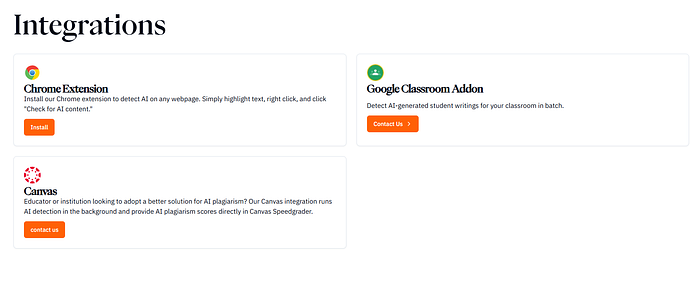
Here are some good sources of protein to add to your meals:
Seafood: Try to have at least two portions a week, including one oily fish like salmon or mackerel.
Poultry and Lean Meats: Pick skinless chicken or turkey and lean cuts of red meat.
Plant-Based Proteins: Add beans, peas, and lentils to soups, stews, and salads.
5. Healthy Fats: Avocados, Olive Oil, and Nuts
While some fats should be limited, your body needs healthy fats to work well. The key is to pick unsaturated fats instead of saturated ones. These better fats can help to lower cholesterol in the blood. Good sources of unsaturated fats include avocados, olive oil, and many nuts and seeds. These foods give essential fatty acids and add flavour and texture to your meals.
Choosing fresh, whole foods for fat instead of processed ones has clear benefits. Fresh foods like avocados and nuts provide nutrients without the unhealthy additives found in many packed snacks. For example, a handful of unsalted nuts is one of the best healthy snacks, giving fibre and healthy fats to keep you full. Using olive oil for cooking or as a salad dressing is an easy way to add healthy fats.
Here are some ways to include more healthy fats in your diet:
Use olive oil as your main cooking oil or pour it over salads.
Add sliced avocados to your toast or salads for a creamy feel and a dose of healthy fat.
Snack on a small amount of unsalted nuts like almonds or walnuts.
How to Identify Truly Healthy Food Products
Shopping in the supermarket can be hard when you want to eat healthily. Many foods say they are healthy, but their packaging can be confusing. So, how can you know if a food is really healthy? The answer is to look past the claims on the front and check the nutrition labels and ingredients list on the back.
To be a smart shopper, you need to learn how to check what is really in your food. By looking at the details, you can make better choices that match your health goals and follow good dietary guidelines. In the next parts, we will look at how to read nutrition labels and find common warning signs like hidden sugars and extra additives.
Understanding Nutrition Labels and Ingredients
To know if a food is healthy, the nutrition label can help you. This label shows the nutrient content for each serving, such as calories, fats, sugars, and salt. When you read the label, first check the serving size. The numbers you see are for that amount, which could be less than what you usually eat.
The ingredients list is also important. Ingredients are shown from the most to the least. If sugar, salt, or bad fats are near the top, it means the product has a lot of these. Also, be careful if the list is long with strange names or chemical words. Food with simple and natural ingredients is usually better.
Here are some things to look for on nutrition labels:
Serving Size: Look at this first to understand the other numbers.
Fat, Sugar, and Salt: Pick foods with less saturated fat, sugars, and salt.
Fibre: Go for foods with more fibre, like whole-grain breads and cereals.
Spotting Hidden Sugars, Additives, and Unnecessary Ingredients
Making healthier choices often means you need to be like a detective when shopping, especially to spot hidden sugars. Sugar comes in many forms and may appear under different names on the label. Words that end with “-ose,” like fructose, sucrose, and maltose, are all sugars. Syrups, nectars, and fruit juice concentrates are also types of sugar.
Besides sugar, it is smart to watch out for long ingredient lists full of additives and things you do not know. Not all additives are bad, but a shorter list usually means the product is less processed and more natural. Getting better nutrition means choosing whole foods, so the fewer extra ingredients, the better. This way also helps you control your calorie intake better.
To help you find less healthy items, remember these tips:
Scan the ingredient list to find many hidden sugars.
Be careful with products that say “low-fat” because they often have added sugar to make them taste better.
Choose products with short, simple ingredient lists that you can easily understand.
Building a Balanced Diet According to Health Experts
So, what does a balanced diet look like according to health experts? It means having variety, the right amounts, and not eating too much or too little. A balanced diet includes foods from all the main food groups to help you get many important nutrients. Following dietary guidelines, like those from the NHS or the USDA, is a good way to plan your meals.
Eating like this helps you keep a healthy weight. It can also lower your chance of getting long-lasting problems like heart disease. The aim is to base your meals on starchy foods with lots of fibre, eat plenty of fruits and vegetables, and have moderate amounts of protein and dairy. In the next parts, we will explain the right portions for each food group and why variety is important.
Recommended Portions of Each Food Group
To create a balanced diet, it helps to know the right servings for each food group. Health guides like the Eatwell Guide or the USDA’s MyPlate show you how to split your plate. Usually, fruits and vegetables should take up the biggest part of your diet, followed by starchy whole grains. A simple daily meal plan might be porridge with fruit for breakfast, a whole-grain sandwich with salad for lunch, and lean protein with lots of vegetables for dinner.
For protein, try to eat some beans, pulses, fish, eggs, or meat every day. Dairy products or their alternatives are also important for calcium. It is best to pick options that have less fat and sugar. Knowing portion sizes is very important. For example, one portion of fruit is about 80g, and a portion of fish is usually about 140g.
Here’s a general guide to the recommended portions:
Fruits and Vegetables: Try for at least 5 portions each day. One portion is about a handful.
Starchy Foods: These should be just over a third of what you eat.
Protein and Dairy: Have moderate amounts every day, choosing lean and low-fat kinds.
The Role of Variety and Moderation in Daily Meals
Two key ideas for healthy eating over a long time are variety and moderation. Eating many different foods helps you get all the vitamins, minerals, and nutrients your body needs to stay well. This means not only eating your favourite vegetables but also adding a variety of vegetables and fruit to your meals each week.
Moderation is just as important. No food needs to be completely avoided. This makes healthy eating easier and more enjoyable for your family. Foods with more fat, salt, or sugar can be eaten sometimes, but in small amounts. This balance stops you from feeling like you are missing out. Healthy snacks, like fruit or unsalted nuts, can help keep hunger away between meals without ruining your healthy habits.
To make healthy eating a family activity, try these ideas:
Let your children help with planning and cooking meals.
Eat meals together as a family regularly to show good eating habits.
Keep mealtimes happy and avoid using food as a reward or punishment.
Frequently Asked Questions (FAQ)
What are some important dietary guidelines to keep a healthy eating routine and prevent heart disease? How can you choose healthier foods, like picking whole grains instead of processed white bread? What are the best protein sources that help with weight loss and lower cholesterol? Find out the health benefits of eating more fruits and vegetables to reduce the chance of heart problems. Learn why it is important to include unsaturated fats and lean meats, while cutting down on saturated fats, to have a balanced diet.
What are the key differences between healthy and unhealthy foods?
The key difference between healthy and unhealthy foods is in their nutrition. Healthy foods, such as fruits, vegetables, and lean proteins, have lots of vitamins, minerals, and fibre. These give many health benefits. On the other hand, unhealthy foods are usually highly processed. They often have large amounts of saturated fat, sugar, salt, and artificial additives. They have very few good nutrients. Eating healthy food all the time helps your well-being. But eating a diet with lots of unhealthy foods can raise your health risks.
Are there any official guidelines or plates that help build a healthy meal?
Yes, there are official dietary guidelines to help you create a healthy and balanced diet. In the UK, the NHS offers the Eatwell Guide. It shows the amounts of each food group you should eat in a simple way. In the United States, the USDA has the MyPlate model. Both these tools divide meals into recommended portions of fruits, vegetables, grains, protein, and dairy. This makes it easier to plan meals that are good for you.
How can I make healthy eating enjoyable and sustainable for my family?
To enjoy healthy eating and keep it going, focus on having a mix of foods and eating in moderation instead of following strict rules. Get your family involved in picking and making meals to make it fun. Try different colourful foods and cook them in new ways. Let yourself have small treats now and then so you don’t feel like you’re missing out. Keeping healthy snacks nearby helps everyone choose better foods during the day. This way, healthy eating becomes an easy and enjoyable part of life.
Conclusion
To sum up, making smart and healthy food choices is very important for improving your overall health. By adding a mix of colourful fruits, leafy greens, whole grains, lean proteins, and healthy fats to your meals, you can create balanced dishes that help your body. Knowing how to read nutrition labels and spotting hidden sugars or additives will help you pick truly healthy foods. Remember, moderation and variety are the keys to a lasting eating plan. This kind of plan not only supports your health but can also be enjoyable for your whole family. If you want to start your journey towards healthier eating habits, get a free consultation with our nutrition experts today!
Embracing healthy eating means making a balanced diet that gives the body food from each of the big food groups.
If you eat more whole grains, fruits, and vegetables, you will get more of the essential vitamins that are needed.
Picking brown rice instead of white rice helps you work towards long-term wellness and better health.
Adding oily fish to your meals each week can lower cholesterol and help cut down the risk of heart disease.
To keep track of your calories in the right way, you need to know about food labels and watch your portion sizes.
A balanced diet is not only about what you avoid. It is also about enjoying more of the good and healthy foods.
Introduction
Welcome to your easy guide to making better food choices! Healthy eating does not have to feel hard. You can start with small, simple changes in your daily dietary patterns. These can give you many health benefits. You may feel more energy and see good changes in your health over time. This guide will show you the basics. It will give you useful tips and simple ideas. You can use them to build a better, happier way to enjoy food. Are you ready to begin?
Understanding Healthy Food Choices
Healthy foods are the ones that come whole and contain important nutrients your body needs to stay well. When you follow dietary guidelines, you bring in things from each main food group. This helps you get all the essential vitamins and minerals to make a balanced diet.
If you look at food this way, you do not just count calories. Instead, you pay attention to what the food gives you. In the next parts, we will talk about what makes something a healthy food and which key nutrients you need to help your overall well-being.
What Makes a Food ‘Healthy’?
When you see the word ‘healthy’ next to a food, it often means the food is a whole food and has many good nutrients. These healthy foods usually do not have much saturated fat, salt, or added sugars. They have real health benefits, as the nutrients in them help your body work well.
Healthy foods have most of the macronutrients you need. For example, they have protein with essential amino acids. These are key for muscle health and can help you stay full for a longer time. You also get vitamins and minerals from these foods. The body cannot make these on its own.
Many of these foods have antioxidants and important plant compounds. These can keep your cells safe from damage. If you eat a diet with lots of these nutrient-rich foods, you can lower your risk of chronic diseases and help to keep your immune system strong.
Key Nutrients to Prioritise in Your Diet
To build a healthy diet, it helps to pay attention to key nutrients that give strong benefits. Omega-3 fatty acids are found in oily fish like salmon and nuts such as walnuts. These are important to reduce inflammation and help your brain and heart. Adding these to your diet is a good way to improve your wellness.
Protein foods are also an important part of good nutrition. Lean meats, eggs, lentils, and beans give your body what it needs to build and repair. Make sure you also take in enough vitamin C, which you can find in oranges, bell peppers, and strawberries. This will help your immune system stay strong.
Remember to include other essential vitamins and minerals in your meals. Potassium, which you can get from bananas and potatoes, helps keep your blood pressure steady. Calcium from dairy is good for keeping your bones strong. Eating a variety of foods is the best way to make sure you are getting all the essential vitamins and nutrients you need.
Building Balanced Meals
Making sure your plate is balanced helps you have meals that taste good and give you what you need. The Eatwell Guide says to pick foods from each main food group. It’s best to start with starchy foods that have more fibre, like potatoes or whole grains.
Next, add a good source of protein foods. Fill most of your plate with colourful vegetables. This way, you get carbohydrates for energy, protein to help your body repair, and vitamins to keep you healthy. Here’s how you can make a balanced plate and some easy tips for you and your family.
The Components of a Balanced Plate
A balanced diet is all about eating a variety of foods from the five main food groups in the right proportions. Visualising your plate can make this much easier. A significant part of your meal, just over a third, should consist of starchy carbohydrates, preferably those with high grams of fiber.
Another third should be filled with fruits and vegetables, ensuring you get at least five portions daily. The remaining third can be split between protein sources and dairy or dairy alternatives. Aim for at least one portion of oily fish per week to get those healthy omega-3 fats.
Here is a simple way to picture your balanced plate according to the Eatwell Guide:
Food Group
Ideal Plate Portion
Examples
Fruits and Vegetables
Just over 1/3 of your plate
Broccoli, carrots, apples, berries
Starchy Carbohydrates
Just over 1/3 of your plate
Potatoes with skin, brown rice, wholewheat pasta
Proteins
A smaller portion
Lean meat, fish, beans, lentils, eggs
Dairy and Alternatives
A small portion
Milk, yoghurt, cheese
Simple Tips for Everyday Healthy Eating
Making healthier choices doesn’t have to be hard. When you follow some easy dietary guidelines, it can improve your day-to-day life a lot. The main idea is to look for balance and to enjoy eating a variety of foods. This helps you get many nutrients your body needs.
Eating less and moving more can help you with weight control. You will take in fewer calories than you burn. Even small steps, such as keeping an eye on your portion sizes or picking foods with less saturated fat, add up as time goes by.
Here are some easy tips to get you started:
Base your meals on higher-fibre starchy carbohydrates.
Eat at least five portions of a variety of fruit and veg every day.
Cut down on saturated fat, sugar, and salt.
Drink plenty of fluids, aiming for 6-8 glasses a day.
Don’t skip breakfast, as it sets you up for the day.
Aim to eat at least two portions of fish a week.
Essential Foods for a Healthy Kitchen
Having healthy foods close by makes it much easier for you to stay with your plan. When your kitchen has lots of good options, you will be less tempted to get things that are not healthy or fast. You set yourself up for a win by doing this!
Your must-have list can have different fruits and vegetables, lean cuts of meat or other good source of protein, and whole grains. These simple foods give you essential vitamins, and they are the base for many healthy meals. Let’s look at some things you can add to your shopping list.
Must-Have Fruits and Vegetables
If you fill your kitchen with a variety of fruit and colourful vegetables, it is one of the best things you can do for your health. The different colours often show the nutrients each one has. When you eat many colours, you get all kinds of benefits. For example, leafy greens such as kale come with lots of vitamin C and K.
Root vegetables such as carrots and sweet potato offer beta-carotene. Your body changes this to vitamin A. Some studies say that eating these colourful vegetables might even help with issues like macular degeneration.
Keep these good and handy picks around:
Berries: Blueberries and strawberries come full of vitamin C and antioxidants.
Leafy Greens: Kale and spinach give you fibre and vitamins.
Bell Peppers: They are sweet, crunchy, and are a strong source of vitamin C.
Avocados: This fruit gives your body good fats, fibre, and potassium.
Lean Proteins for Family Meals
Protein is needed at every meal because it helps with muscle repair and keeps you satisfied. Choosing lean protein foods is a smart way to get the good things in protein without a lot of saturated fat. When you buy meat, pick lean cuts and cut away any fat you see before you cook it.
Meat is not the only good source of protein. Legumes like beans and lentils are great plant options, and they are also high in fibre. Oily fish, such as salmon or mackerel, in your family’s meals at least once a week, brings heart-friendly omega-3 fatty acids. This can help look after their cholesterol levels.
Have these protein foods ready for easy family dinners:
Chicken Breast: It has little fat and low calories, plus it is high in protein.
Eggs: A healthy and flexible food with much protein.
Lentils and Beans: They offer good plant protein as well as fibre.
Salmon: This oily fish comes with important protein and omega-3 fatty acids.
Smart Food Swaps for Better Health
You don’t have to change your whole diet to get better health. Making small and smart changes in what you eat can help you get big results for your good health. For example, swap white bread for whole grains. This easy change will help you get more fibre.
These healthier choices are simple for anyone to start. They fit well with dietary guidelines too. By picking easy substitutions, you can slowly make your diet better without feeling you are losing out. Let’s look at some easy swaps you can try with grains, sugar, and salt.
Replacing Refined Grains with Whole Grains
One of the best ways to eat better is to pick whole grains instead of refined ones. Whole grains have more fibre, so they help you feel full for a longer time. They are also good for your digestive health. Unlike white bread and other refined grains, whole grains have the whole kernel, which means you get more vitamins and minerals.
When you go shopping, check the packs for words like “wholewheat” or “wholegrain”. Doing this can help you, and your family, make a much better choice. For example, choose brown rice instead of white rice to get more goodness in your meals.
Try these swaps to eat more whole grains and get higher fibre:
Switch from white bread to wholewheat or seeded bread.
Choose brown rice or quinoa instead of white rice.
Opt for wholewheat pasta over white pasta.
Select breakfast cereals with higher fibre, such as oats or shredded wholewheat.
Healthier Alternatives to Sugar and Salt
Many of us eat too much salt and sugar, and we may not even know it. If you eat foods high in sugar often, you can put yourself at risk for weight gain and tooth decay. Eating too much salt is bad as it can raise your blood pressure. Cutting down on these is one good step for your health.
You will find a lot of the salt and sugar you eat in processed foods. This is why looking at food labels is important. When you cook, use herbs, spices, garlic, or a little lemon juice for flavour instead of salt. For fat, it is good to use a small bit of olive oil rather than butter or lard. This is better for your heart.
Here are some ways to cut down on salt and sugar:
Flavour your meals by using herbs and spices instead of salt.
Swap sugary drinks for water, lower-fat milk, or drinks that are sugar-free.
Pick fruit for dessert instead of cakes or puddings.
Check the food labels on sauces and cereals for any hidden sugars and salt.
Healthy Meal Ideas and Easy Recipes
Making healthy eating part of your life starts with having some easy meals you know you can make. If you stick to simple recipes with good ingredients, you can make meals that taste great and are good for you, without taking up all your time in the kitchen. Using whole foods helps you have a balanced diet and can also help if you want to focus on weight management.
If you feel like you need some new ideas, there are quick breakfast, lunch, and dinner dishes that are easy to get ready and have plenty of nutrition. These ideas for healthy eating can help you keep up with your balanced diet and your goals every day.
Quick Breakfasts Packed with Nutrition
Starting your day with a healthy breakfast is a good way to get the nutrients you need for good health. Eating a balanced morning meal that is high in fibre and has little fat can help you avoid feeling tired before lunch. A good breakfast like this can be part of a balanced diet.
Breakfast cereals are easy to eat but many have a lot of sugar. It is better to pick wholegrain, lower-sugar breakfast cereals. When you have a variety of foods for breakfast, you give your body essential vitamins and a good number of grams of fiber. This helps you stay full and with enough energy until it is time for lunch.
You can try these quick and healthy breakfast ideas:
A bowl of wholegrain cereal with semi-skimmed milk and sliced banana.
Porridge made with oats and topped with berries.
Scrambled eggs on a slice of wholewheat toast.
A smoothie made with yoghurt, fruit, and a handful of spinach.
Nourishing Lunches and Dinners Using Whole Foods
For lunch and dinner, try to put together a balanced plate with whole foods. You want to include a good source of protein, some starchy foods to give you energy, and a lot of vegetables. This easy guide will help you make healthy and filling meals every time.
Think about adding lean protein, such as chicken or fish, to your meal. Oily fish, like salmon, give you key nutrients, including vitamin D and omega-3s. Adding a colourful salad or steamed vegetables brings in more vitamins and minerals. This will help you make the perfect balanced plate with a mix of everything you need.
Here are some meal ideas that are good for you:
Grilled chicken breast with a big mixed salad and a side of quinoa.
A baked salmon fillet with roasted sweet potatoes and broccoli.
Lentil soup served with a slice of wholewheat bread.
A homemade curry made with chickpeas, spinach, and brown rice.
Healthy Eating for Disease Prevention
The food that you eat can have a big effect on your health over time. When you have a balanced diet, you can lower your risk of heart disease and stop other health problems. If you pay attention to your food choices, you can manage your cholesterol levels and help keep your blood pressure in a good range.
Some foods work well to protect your body and can bring down the risk of cardiovascular disease. In the next sections, you will see which foods support heart health and cut your risk of getting long-term diseases. This will help you take charge of your well-being.
Foods Proven to Support Heart Health
Looking after your heart starts with what you eat. Some foods have nutrients that can help to lower cholesterol, manage blood pressure, and reduce the risk of heart trouble. One good way is to add more omega-3 fatty acids to your meals.
You also need to have less saturated fat. This kind of fat is found in fatty meats, butter, and many processed foods. Try to use unsaturated fats instead, like the ones in avocados and nuts. Cooking with olive oil or using it in salads is a simple way to make a heart-healthy change.
Add these foods to your diet for better heart health:
Oily Fish: Salmon, mackerel, and sardines have lots of omega-3s.
Oats: Oats have a type of fibre called beta-glucan that helps to lower cholesterol.
Nuts and Seeds: Almonds and walnuts are good for you. They give you healthy fats and fibre.
Garlic: Garlic may help lower blood pressure. It also has properties that protect your cells.
Choices That Help Lower Chronic Disease Risk
Eating a diet made up of whole, natural foods is one of the best ways to protect yourself against long-term health problems, like heart disease. When you choose to eat fruits, vegetables, whole grains, and lean proteins, you can bring down your risk of heart disease, type 2 diabetes, and more. These foods have a lot of vitamins, minerals, and good things, like antioxidants, that help your body stay strong.
Healthy fatty acids, such as omega-3s, help lower swelling in the body and help keep your blood cholesterol levels in a good range. This stops plaque from building up in your arteries, which leads to cardiovascular disease.
To lower your risk of heart disease and other health problems, try to:
Eat many types of bright fruits and vegetables each day.
Choose whole grains to get more fibre into your diet, instead of refined grains.
Use lean protein, and don’t forget plant options, such as beans.
Cut down on processed foods that are high in sugar, salt, and bad fats.
Conclusion
To sum up, picking healthy foods is key for your health and helps stop long-term illness. When you know what makes a food good for you and you focus on the right nutrients, you start to live better. Making good, balanced meals is the way to go. If you add important foods and good changes like whole grains to your meals, you will start to feel better. Small steps matter, such as choosing whole grains instead of other grains or adding more fruit and veg to your plate. Are you ready to change the way you eat and make smart choices for better health? The first step can happen today. Get a free chat with our nutrition experts and let them help you get started!
Here is a quick overview of what this guide covers to help you start healthy eating.
A healthy diet includes many whole foods like fruits, vegetables, lean proteins, and whole grains.
Choosing smart options, such as eating more fish and reducing saturated fat, can lower your risk of heart disease.
Knowing how to read food labels helps you find hidden sugars and high salt in packaged food products.
Following dietary guidelines can help you control your body weight and lower the chance of problems like high blood pressure.
Adding healthy foods to your daily meals does not have to be hard; simple changes can make a big difference.
Some foods, like oats, nuts, and oily fish, are very good for stopping cardiovascular disease and keeping your heart healthy.
Introduction
Starting a journey towards healthy eating is one of the best things you can do for your body and mind. It is not about strict rules but about feeling good, having more energy, and improving your overall health. The key is to follow simple dietary guidelines that focus on eating a variety of nutritious foods. Eating the right amount of calories for your activity level helps you balance the energy you take in with what you use. This is important for keeping a healthy body weight. This guide will show you the main foods to add to your plate and helpful tips to make healthy choices easy and enjoyable every day.
Essential Healthy Food Choices for Daily Eating
Creating a balanced diet means eating different foods from each main food group. This helps your body get all the essential nutrients it needs. The best healthy foods to eat every day are whole and unprocessed. Think of colourful fruits and vegetables, lean proteins, and whole grains full of fibre. These foods have vitamins, minerals, and antioxidants. They give many health benefits, like helping your immune system and keeping you feeling full and full of energy all day.
Small changes can make a big difference. You could swap your usual mid-morning snack for a piece of fruit. Or add a starchy food like potatoes with their skins on to each meal. These are easy ways to start. When you add more of these nutrient-rich foods, you make a good base for long-term health and well-being. Let’s look at some of the best foods you can add to your shopping list.
1. Leafy greens (spinach, kale, Swiss chard)
Green leafy vegetables are full of nutrients and a great part of any daily diet. Take kale, for example. It has a lot of fibre, vitamin C, and vitamin K. These nutrients help support your overall health. You can eat kale raw in salads for a crunchy texture, add it to stir-fries, or bake it into crispy chips for a healthy snack.
Spinach and Swiss chard are also great options. They are easy to cook and very flexible in meals. Like other dark green leafy vegetables, they have good compounds that protect your cells from damage. The antioxidants in these greens help with many health benefits. Eating different kinds of these vegetables means you get a wide range of nutrients.
Adding these greens to your meals is easy. You can put a handful of spinach in your morning smoothie, use Swiss chard in soups and stews, or sauté them with a little garlic for a quick and tasty side dish. Because they have many nutrients but few calories, they are good for keeping a healthy body weight.
Cruciferous vegetables like broccoli, cauliflower, and Brussels sprouts are known for their healthy benefits. Broccoli stands out as a great source of fibre, vitamin C, and vitamin K. It also has more protein than many other vegetables. You can eat it raw with a dip or cook it lightly to keep its crunch and nutrients.
These vegetables are a great source of antioxidants. These help protect your body’s cells from damage. Eating them regularly can support the health of your blood vessels and help your overall well-being. Cauliflower is very flexible. You can roast it with olive oil, add it to curries, or eat it raw in salads. Its mild flavour works well in many dishes.
Brussels sprouts, part of the same family, offer similar benefits. When cooked well, they can be a tasty part of any meal. Roasting them brings out a sweeter, nuttier flavour. Adding different cruciferous vegetables to your meals can easily increase your intake of important nutrients and help with your long-term health goals.
Berries like blueberries, strawberries, and raspberries are not just tasty but also full of nutrients. This makes them one of the best healthy food choices. Blueberries are well known for having a lot of antioxidants. These strong compounds help protect your body from damage to cells, which can cause different health problems. Their sweet flavour makes them easy and enjoyable to eat.
Strawberries are another great choice. They have many nutrients but are low in carbs and calories. A serving of strawberries gives you a good amount of vitamin C, fibre, and manganese. You can eat them by themselves, add them to your breakfast cereal, or use them in a healthy dessert. The natural sweetness in berries can help you satisfy a sugar craving in a much better way.
All colourful berries have many bioactive compounds that give them their health benefits. Raspberries, cherries, and grapes are also great to add to your meals and snacks. Since they need little or no prep, they are an easy way to increase your daily intake of vitamins and fibre. Eating a mix of berries ensures you get many different protective nutrients.
4. Citrus fruits (oranges, grapefruits, lemons)
Citrus fruits are known for being a great source of vitamin C, which is an important nutrient that helps your immune system. Oranges, grapefruits, and lemons are popular fruits that also have a lot of fibre and antioxidants. Eating these fruits is an easy way to get the nutrients you need each day and to support your overall health.
The dietary guidelines say that eating different kinds of fruits is important for a healthy diet. The substances in citrus fruits can help lower the risk of heart disease by keeping the heart and blood vessels healthy. Eating an orange as a snack or putting lemon juice on a salad are simple ways to add these fruits to your day. While a randomized controlled trial can give detailed information, the general view is that these fruits are very good for you.
Enjoying citrus fruits is simple and refreshing. Here are some ideas:
Add slices of orange or grapefruit to your water for a tasty and cooling drink.
Use lemon juice as a salad dressing or on cooked vegetables instead of heavy sauces.
Start your day with half a grapefruit for a healthy and low-calorie breakfast.
5. Nuts and seeds (almonds, walnuts, chia seeds)
Nuts and seeds may be small, but they are very good for your health. They have a lot of calories and healthy fats. Studies show that eating them can lower the risk of heart problems and other health issues. They also make a filling snack that helps you feel full for longer. This can help you control your weight.
Almonds are a common choice. They have vitamin E, antioxidants, magnesium, and fibre. Research shows almonds can help your gut stay healthy and keep your skin looking good. Walnuts are also a great choice. They have fibre and many vitamins. Chia seeds are very full of nutrients too. Just one ounce of chia seeds has almost 10 grams of fibre, plus magnesium and calcium.
It’s very easy to add nuts and seeds to your diet because they need little or no preparation.
Sprinkle a handful of almonds or walnuts on your salad for extra crunch and nutrients.
Add a tablespoon of chia seeds to your yoghurt or smoothie in the morning.
Carry a small bag of mixed nuts and seeds with you for a quick, healthy snack when you are out.
6. Whole grains (quinoa, brown rice, oats)
Whole grains are a crucial part of a healthy diet, providing fuel for your body, fibre, and a variety of micronutrients. They should make up just over a third of the food you eat. Choosing higher fibre or wholegrain varieties like wholewheat pasta, brown rice, or potatoes with their skins on can help you feel full for longer.
Oats are particularly beneficial, as they contain powerful fibres called beta-glucans. These fibres have been shown to help lower cholesterol and feed the good bacteria in your gut. Brown rice is more nutritious than its white counterpart, offering good amounts of fibre, magnesium, and B vitamins. Quinoa is another excellent choice; it’s high in fibre and magnesium and serves as a great source of plant-based protein. These grains can also help manage blood sugar levels.
Incorporating different whole grains ensures a wider range of nutrients. Here is a quick comparison of some popular choices:
Whole Grain
Key Benefits
Oats
Contains beta-glucans to help lower cholesterol and supports gut health.
Brown Rice
A good source of fibre, vitamin B1, and magnesium; more nutritious than white rice.
Quinoa
A complete plant-based protein, high in fibre and essential minerals like magnesium.
7. Legumes (beans, lentils, chickpeas)
Legumes, like beans, lentils, and chickpeas, are a great plant-based source of protein, iron, and fibre. They play a key role in healthy eating and dietary guidelines because they are packed with nutrients and easy to use in many dishes. Eating legumes can help you feel full and satisfied, so they are a good choice to manage your energy intake during the day.
Legumes are also excellent protein foods and can replace meat well. For instance, kidney beans are full of fibre and many vitamins and minerals. However, it is important to cook them properly because raw kidney beans can be harmful. Lentils are another popular legume, rich in fibre and a good source of plant protein. This makes them a main part of healthy diets worldwide.
You can add legumes to your meals in many simple ways. Throw chickpeas into a salad, make a thick lentil soup, or add kidney beans to a chilli. Green beans are also a great option and can be eaten on their own or added to salads. Using different kinds of legumes helps you get more essential nutrients and makes your meals more filling without needing animal products.
Fats and oils play a key role in a healthy diet, but it is important to pick the right ones. Diets that include unsaturated fats and oils are known to be very good for health. Extra-virgin olive oil is one of the best options you can choose. It is full of heart-friendly monounsaturated fats and has antioxidants that bring strong health benefits.
Replacing saturated fats like butter or lard with virgin olive oil is an easy step towards better health. The special fatty acid makeup of olive oil helps your heart and blood vessels. While oils such as avocado oil also have healthy fats, extra-virgin olive oil is especially praised for its health benefits.
Here are some simple ways to add healthy oils to your meals:
Drizzle extra-virgin olive oil on salads for a quick and tasty dressing.
Use a little olive oil when roasting vegetables or cooking lean meats.
Pick spreads made from vegetable or olive oils for your toast instead of butter.
9. Fatty fish (salmon, sardines, trout)
Fish and seafood are very healthy and full of nutrients, especially oily fish like salmon, sardines, and trout. They have a lot of omega-3 fatty acids and iodine, which many people do not get enough of. Studies show that eating oily fish often can help your heart and brain stay healthy. This makes oily fish an important part of a diet to prevent cardiovascular disease.
Salmon is a popular choice. It tastes great and is high in protein and omega-3s. It also has some vitamin D, which is hard to find in many foods. Sardines are another great option. These small oily fish are very good for you and give you a good amount of calcium and vitamin D. It is good to eat at least two portions of fish a week, and one of these should be oily fish.
Fish also gives you protein with many essential amino acids your body needs. You can choose fresh, frozen, or canned fish. Tuna is another good pick because it usually has low fat and calories but lots of protein. When you buy fish, try to pick ones that are caught in a responsible way to make sure they are fresh and of good quality.
10. Eggs
Eggs are one of the most nutritious foods you can eat. For a long time, people thought they raised cholesterol. But now, we know they are a great source of protein with many benefits. Eggs have essential nutrients that are important for good health. This makes them a smart choice for any meal during the day.
As excellent protein foods, eggs help you feel full and satisfied. This can be good for managing your weight. One egg has high-quality protein, vitamins, and minerals. They are an easy and cheap way to add more nutrients to your diet. This fits well with healthy dietary guidelines.
You can enjoy eggs in many ways. Boil them for a quick snack, scramble them for breakfast, or put a fried egg on brown rice and vegetables for a full meal. Their versatility makes it simple to include these nutritious foods in your weekly plan.
11. Low-fat dairy (Greek yogurt, cottage cheese)
For those who can have them, dairy products are a healthy source of many key nutrients. Low-fat dairy options like Greek yogurt and cottage cheese give good health benefits without the high saturated fat found in full-fat versions. Dairy milk, for example, has vitamins, minerals, good protein, and calcium, which is very important for bone health.
Yogurt, especially types with live cultures, gives an extra benefit of friendly probiotic bacteria. These probiotics help your gut health. Greek yogurt has a lot of protein, which can help you feel full for longer. Cottage cheese is also a high-protein, low-fat choice that works well as a snack or part of a meal.
Research shows that people who eat dairy products may have a lower chance of dying from cardiovascular disease. Picking lower-fat milk and other low-fat dairy is a smart way to get all the health benefits while keeping control of certain fats. You can add yogurt to smoothies, put fruit on top, or use cottage cheese as a creamy base for savoury dishes.
12. Sweet potatoes
Sweet potatoes are a tasty and healthy root vegetable that should be on your plate. They have antioxidants, beta-carotene, and vitamin A, all of which help your overall health. Unlike normal potatoes, they are naturally sweet, making them a nice addition to many meals.
Sweet potatoes are a good source of fiber, which helps keep your digestion healthy. They can also help manage blood sugar levels. They have a bit of almost every nutrient you need, including vitamin C. The fiber in sweet potatoes helps you feel full, so you may eat less and this can help with weight control.
There are many ways to enjoy sweet potatoes. You can bake them whole, mash them for a side dish, or cut them into cubes and roast them with olive oil and herbs. Their flexibility and strong nutrition make them a great choice for anyone wanting to eat more healthy carbohydrates.
13. Tomatoes
Although tomatoes are technically a fruit, people usually use them as a vegetable when cooking. They taste great and have many nutrients like potassium and vitamin C. Tomatoes are also full of strong antioxidants, such as lycopene. This gives them their bright red colour and is linked to many health benefits.
Eating tomatoes can be good for your heart. The nutrients and antioxidants in them may help lower the risk of heart disease. It is easy to follow dietary guidelines that suggest eating many fruits and vegetables when you add flexible foods like tomatoes to your meals.
You can eat tomatoes in many ways. Put them fresh in salads and sandwiches, cook them into pasta sauces, or roast them to bring out their sweet taste. They add a fresh burst and colour to any meal. For extra fun and flavour, you can even try growing your own tomatoes on a windowsill.
14. Avocado
Avocados are different from most fruits because they have healthy fats instead of carbs. These monounsaturated fats are good for your heart and help your overall health. Besides healthy fats, avocados also have a lot of fibre, potassium, and vitamin C. This makes them a very nutritious food.
The healthy fats and potassium in avocados can help control blood pressure. Their soft texture and rich flavour make them a tasty part of any meal. You can use avocado as a healthy option instead of less healthy spreads like mayonnaise on your sandwiches or toast.
It’s easy to add avocado to your diet. You can put slices in salads, mix it into smoothies for a smooth taste, or mash it with lime juice and garlic to make quick guacamole. Eating avocados often is a tasty way to get more good nutrients and support your health.
Simple Everyday Tips for Making Healthy Food Choices
Eating a healthy diet does not have to feel very hard. Small, simple steps can help improve your overall health a lot. One good tip is to not skip breakfast. A healthy breakfast with lots of fibre and little sugar gives you the nutrients you need for good health. It also helps you make better food choices during the day. Another easy tip is to drink enough water. The government says you should drink 6 to 8 glasses of fluids each day to stay hydrated.
It is also important to mix a healthy diet with regular physical activity. This helps lower the chance of serious health problems. Small changes, like picking whole grains instead of refined ones or using olive oil in place of butter, are good ways to follow dietary guidelines. Below, we will look at more helpful ideas, like planning your meals and checking food labels. These can help you make healthy and smart choices every day.
15. Plan meals using MyPlate or Healthy Eating Plate principles
Visual guides like MyPlate or the NHS Eatwell Guide, also known as the Healthy Eating Plate, are great tools to help you plan balanced meals. These guides show you what a healthy plate looks like by splitting it into sections for each main food group. The aim is to have half of your plate filled with fruits and vegetables, a quarter with lean protein, and a quarter with whole grains. This clear picture makes it easier to control portion sizes.
Using these plate models takes the guesswork out of healthy eating. Instead of counting calories, you focus on getting the right mix of food groups. For example, the Healthy Eating Plate suggests filling your plate with colourful vegetables, picking whole grains like brown rice or quinoa, and choosing healthy proteins such as fish, beans, or poultry. It also reminds you to use healthy oils but in small amounts.
By following these steps, you can be sure your meals are both nutritious and satisfying. Here is how these guides can help you shape your eating habits:
They encourage variety, which helps you eat different foods from each food group.
They give you a clear and simple way to make healthy meals without any hard rules.
They help you see the right portion sizes, which is important to keep a healthy weight.
16. Read food labels to spot truly healthy options
Shopping at the supermarket can be hard, but knowing how to read food labels is a great help for finding healthy food products. Many packaged foods have a lot of sugar, salt, and bad fats. By looking at the nutrition facts, you can choose better options for your shopping trolley.
Look closely at the “per 100g” column on the label. This helps you compare different products easily. Try to find foods low in sugar, saturated fat, and salt. For example, food with more than 22.5g of total sugars per 100g is high in sugar. Food with more than 1.5g of salt per 100g is high in salt. Checking the calorie content also helps you control your energy intake.
Here are some key things to check on a food label to find healthy choices:
Low Saturated Fat: Men should have no more than 30g of saturated fat daily. Women should have no more than 20g. Pick products with less saturated fat.
Low Sugar: Foods with 5g of total sugars or less per 100g are low in sugar.
Low Salt: Try to choose food with less salt. Adults should have no more than 6g of salt each day.
17. Stock up on affordable pantry staples
Keeping your kitchen stocked with cheap and healthy pantry staples is one of the easiest ways to make sure you can always cook a healthy meal. A pantry full of good ingredients stops you from choosing less healthy takeaway when you don’t have much time. These staples are the base of a balanced diet and can be used in many different meals.
What cheap healthy foods should you always have at home? Think about flexible ingredients that last a long time. Canned foods like beans, lentils, and tomatoes are great options. Whole grains such as brown rice, oats, and quinoa are also important to have. These foods are not only low cost but also full of fibre and essential nutrients.
Having these basics ready makes healthy eating easy. You can quickly make a filling meal without needing to rush to the shop. Here are some key pantry staples to keep in your kitchen:
Legumes: Canned beans (kidney, black, chickpeas) and lentils are good sources of plant-based protein.
Whole Grains: Oats for breakfast, brown rice for dinner, and quinoa for salads.
Healthy Snacks: Keep nuts, seeds, and dried fruit ready for a quick and healthy snack.
Special Focus: Heart-Healthy Foods
Taking care of your heart is one of the best things you can do for your health in the long run. The food you eat plays a big part in controlling things like blood pressure and cholesterol. These factors affect your risk of heart disease. Following diets that are full of certain nutrients can help protect your heart and blood vessels. Are there foods that are good for the heart? Yes, there are.
Foods that have fibre, healthy fats, and antioxidants are very good for your heart. For example, some whole grains can help lower cholesterol. Nuts and seeds give you fats that help keep blood pressure healthy. When you add these healthy foods to your meals, you are doing something good for your heart. In the next parts, we will look at some of the best foods to eat for a healthy heart.
18. Oats and barley for cholesterol support
When it comes to supporting healthy cholesterol levels, oats are a real winner. They have a type of soluble fibre called beta-glucan. This fibre helps to lower cholesterol. It creates a gel-like material in your digestive system. This gel catches cholesterol-rich substances and stops them from getting into your body.
Eating oats regularly is an easy and good way to look after your heart. Lowering cholesterol in your blood can cut the chance of heart disease. You can enjoy a warm bowl of porridge for breakfast, add oats to smoothies, or use them in baking for an extra fibre boost.
Besides oats, other whole grains like barley offer similar heart benefits because they also have fibre. Including these grains in your meals often is a smart choice for a healthy diet. Here is how they help:
They give soluble fibre that helps to lower cholesterol.
They can help you feel full for longer, which helps with weight control.
They add to a heart-healthy diet that lowers the risk of long-term cardiovascular disease.
19. Nuts and seeds for healthy fats
Nuts and seeds are great for heart health because they have healthy fats, fibre, and minerals. Though they have a lot of calories, eating them in small amounts can give many benefits, like helping to lower blood pressure. Many studies, including a systematic review, have shown that eating nuts can reduce the risk of heart problems.
The healthy fats in nuts and seeds, like monounsaturated and polyunsaturated fats, are good for your heart. For example, walnuts are full of omega-3 fatty acids, a kind of polyunsaturated fat that helps protect the heart. Almonds, macadamia nuts, and chia seeds are also very healthy choices that give many nutrients.
It is easy to add them to your meals, and they bring good texture and flavour. Here are some ways to get their benefits:
Snack on a small handful of mixed nuts instead of eating processed snacks.
Sprinkle seeds like chia or flax on your morning yoghurt or cereal.
Add chopped walnuts or almonds to your salads for a nice crunch and a boost of healthy fats.
20. Colourful vegetables for antioxidants
Eating a range of colourful vegetables is one of the best ways to care for your heart. The bright colours in vegetables like bell peppers, carrots, and tomatoes come from different antioxidants and phytonutrients. These strong compounds help protect your body’s cells from harm and can lower inflammation. Inflammation is a big cause of many chronic diseases.
Antioxidants are very important for keeping your blood vessels healthy. They help keep your blood vessels soft and clear, which supports good blood flow and reduces pressure on your heart. Bell peppers are a great source of antioxidants and vitamin C. Carrots have a lot of carotene antioxidants, which are good for your whole body.
Eating a variety of vegetables is the best way to get many different nutrients.
Aim to fill half your plate with vegetables at every meal.
Include vegetables of different colours, like green broccoli, red tomatoes, and yellow peppers.
Snack on raw vegetables like cucumber or carrot sticks for a healthy, crunchy treat.
Healthy Food Choices for Families and Children
It is very important to build healthy eating habits in children from a young age for their growth and long-term health. As a parent, you play a big role in shaping your child’s eating habits. Creating a happy and healthy food atmosphere at home helps children enjoy food and keep a healthy body weight.
Eating together as a family gives a good chance to show healthy habits. Instead of telling children what not to eat, it works better to teach them how to enjoy a healthy diet with tasty and good-for-you foods. How can you help your children choose healthy food? It begins by offering healthy choices and getting them involved. The tips below offer fun and useful ways to help your family eat healthy together.
21. Fun ways to encourage kids to eat fruit and veg
Getting children to eat their fruit and veg can sometimes feel like a battle, but with some creativity, it can be fun. One of the best ways to help your children make better choices is to involve them in the process. Take them grocery shopping and let them pick out a new vegetable to try. When they have a say in what goes into the trolley, they are often more excited to eat it.
How you serve fruits and vegetables can also make a big difference. Cut them into fun shapes with cookie cutters or arrange them on a plate to make a smiley face or a rainbow. Offering a variety of vegetables with a healthy dip like hummus can make them more tempting. These options are much healthier snacks than sugary treats.
It is important to lead by example. If your children see you enjoying a wide range of fruits and vegetables, they are more likely to try them too. Here are some simple ideas:
Make fruit kebabs for a colourful and easy-to-eat snack.
Blend fruit and a little low-fat yoghurt into a smoothie. Remember, dietary guidelines suggest limiting fruit juice and smoothies to one small glass a day because of their sugar content.
“Hide” grated or pureed vegetables like carrots and zucchini in pasta sauces or meatballs.
22. Easy swaps for healthier family meals
Making family meals healthier does not mean you have to change your favourite dishes completely. Often, simple swaps can add more nutrition to a meal without anyone noticing. These small changes can bring big health benefits for the whole family. They also help your children learn to make better food choices.
One of the easiest swaps is to choose whole grains instead of refined ones. For example, use brown rice instead of white rice, or wholewheat pasta rather than regular pasta. For protein, pick lean meats like chicken breast or turkey mince. Try to cut off any visible fat before you cook. It is also important to reduce the amount of salt in your cooking. Many foods already have a lot of salt. So, try using herbs and spices for flavour instead of adding table salt.
You can also swap condiments for healthier options. Here are some simple ideas:
Swap white bread for wholemeal or wholegrain types in sandwiches and for toast.
Choose lean meats and cut off visible fat instead of fatty cuts of meat.
Use low-sodium soy sauce or other flavourings instead of adding more table salt to dishes.
Conclusion
In conclusion, choosing healthy food is not just about following fashions. It is about building a lifestyle that supports your overall health. By adding different nutrient-rich foods to your daily meals—like leafy greens, colourful fruits, and whole grains—you can greatly improve your health. Remember, small and steady changes can bring lasting benefits. Also, including your family in this journey can make healthy eating fun and easier to keep up. As you start this journey towards better nutrition, don’t be afraid to ask for help and advice. Get a free consultation with our experts to guide you on the path to a healthier lifestyle!
Frequently Asked Questions
23. How can I tell if a supermarket food is truly healthy?
To know if a food from the supermarket is really healthy, you need to act like a label detective. Check the nutritional info on food products, especially the “per 100g” column. This part makes it easy to compare different items. Dietary guidelines say you should pick foods that have low amounts of saturated fat, sugar, and salt. If a food has more than 1.5g of salt per 100g, it is high in salt. Also, look at the calorie content to be sure it fits your daily needs.
24. What foods should I always keep in my kitchen for balanced eating?
For a balanced diet, keep your kitchen well stocked with versatile pantry essentials. Always have whole grains like oats and brown rice ready to use. Keep canned legumes such as beans and lentils for quick protein options. Having healthy snacks like nuts and seeds on hand helps stop hunger between meals. These items make it easy to cook a healthy meal anytime and help you get a range of essential nutrients without needing a last-minute shop.
25. Are there specific foods that help support heart health?
Yes, many foods help keep your heart healthy. To lower cholesterol, eat oats and barley. Their soluble fibre can help bring cholesterol down. Nuts and seeds have healthy fats that can lower blood pressure. Oily fish like salmon contain omega-3s. These reduce the risk of cardiovascular disease. Colourful fruits and vegetables have antioxidants that protect the heart. Adding these foods to your diet is a good way to improve heart health.
Here is a quick guide to healthy eating and what we will cover. Making smart food choices helps you feel good and stay healthy.
A balanced diet means eating many different foods from all the main food groups in the right amounts.
To focus on good nutrition, include lots of fruits, vegetables, and whole grains like brown rice and oats in your meals.
Lean proteins such as poultry and fish, along with plant-based foods like beans and lentils, are important for your body to grow and heal.
Choosing unsaturated fats from foods like olive oil and nuts helps lower cholesterol and keeps your heart healthy.
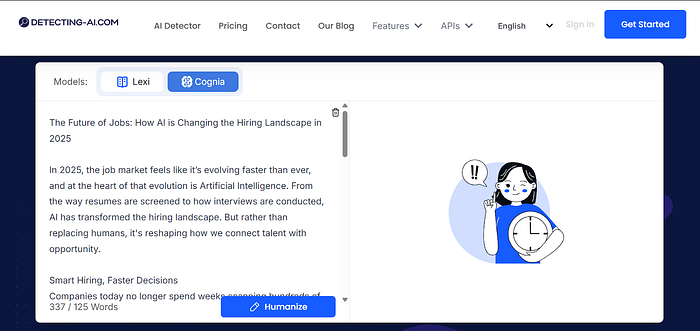
Knowing how to read food labels helps you find hidden sugars and make healthier choices at the shop.
Try to eat at least five portions of fruit and vegetables every day to lower the chance of serious health problems.
Introduction
Starting a journey towards healthy eating is one of the best things you can do for your overall health. It is not about strict diets but about enjoying a range of nutritious foods that give your body what it needs to stay strong. Good nutrition has many health benefits. It can increase your energy and lower the risk of heart disease. By learning about different dietary patterns and the best foods to include in a healthy diet, you can make simple changes that help you become healthier and happier. This guide will help you create a balanced diet full of tasty and wholesome foods, making healthy eating a part of your life that lasts.
The Ultimate Guide to Healthy Food Choices: Essential Foods for Every Kitchen
To make healthy eating easier, it is good to keep your kitchen stocked with the right foods. When you have healthy options ready, you are more likely to choose them, even when your day is busy. Think of your kitchen as the base of your health. If it has a variety of fruit, a variety of vegetables, and other good foods, you are set for success.
Following general dietary guidelines helps you get all the important nutrients your body needs. Keeping key foods from each food group is a smart plan. This means having colourful vegetables and fruit, lean proteins, whole grains, and healthy fats. Below, we will look at some of the best foods to always have in your kitchen to make balanced and tasty meals.
1. Colourful Fruits and Berries
Eating a variety of fruit is a great way to improve your health. Fruits are full of vitamins, minerals, and fibre. Berries are especially known for their high levels of antioxidants, which help protect your body. It is good to eat at least five portions of fruit and vegetables every day. This can lower your risk of heart disease and stroke and bring many other health benefits.
It is best to choose fresh fruit rather than processed ones. Fresh fruit keeps all its nutrients and does not have added sugar, salt, or preservatives like many packaged foods do. A banana or an apple is a good snack that is easy to carry and healthy. You can put fruit on your breakfast cereal, eat it with yoghurt, or just have it on its own.
Adding fruit to your meals and snacks does not have to be hard. Here are some easy ways to eat more fruit:
Add a spoonful of dried raisins to your morning porridge.
Change your mid-morning biscuit for a pear or some berries.
Have a slice of melon or pineapple as a fresh dessert.
2. Leafy Greens and Cruciferous Vegetables
Vegetables, especially leafy greens and cruciferous types, are full of nutrition. Eating more of these veggies in your meals is one of the best ways to improve your diet. They provide lots of vitamins and fibre and should make up more than a third of the food you eat every day. Studies show that a diet rich in vegetables can help lower the risk of heart disease and control blood pressure.
Foods like kale, spinach, and broccoli are some of the best to include in a healthy diet. They are easy to use and can go with almost any meal. You can steam them as a side dish, blend them into smoothies, or add them to salads and stir-fries. Even simple snacks, like celery sticks with a healthy dip, can add to your daily veggie intake and give you important nutrients.
Getting your five-a-day is easier than you think. Just three heaped tablespoons of cooked vegetables count as one portion. Here are some ideas to help you:
Add a side salad to your lunch for a quick and easy portion of veggies.
Have a portion of green vegetables like peas or broccoli with your evening meal.
Snack on crunchy vegetables like carrot or celery sticks instead of crisps.
3. Whole Grains and Ancient Grains
Starchy foods should form the base of your meals, making up just over a third of what you eat. When choosing these foods, it’s best to opt for whole grains. Unlike refined grains, whole grains contain more fibre, vitamins, and minerals. Simple swaps, like choosing brown rice instead of white, can make a big difference to your daily nutrition. Ancient grains like quinoa are also excellent choices.
Incorporating whole grains into your diet is simple. Start your day with a bowl of oats, choose wholewheat bread for your sandwiches, or base your evening meal around wholewheat pasta or brown rice. According to dietary guidelines, these foods provide sustained energy and support good digestive health. Potatoes with their skins on are another great source of fibre and vitamins.
For busy days, having some quick and healthy recipe ideas can be a lifesaver. Here are a few simple ways to use different whole grains:
Grain Type
Easy Meal Idea
Oats
Prepare overnight oats with fruit and nuts for a grab-and-go breakfast.
Quinoa
Make a large batch of quinoa salad with chopped vegetables and a light vinaigrette for easy lunches.
Brown Rice
Use leftover brown rice for a quick vegetable stir-fry with lean protein.
4. Lean Proteins: Poultry, Fish, and Plant-Based Sources
Protein is important for your body to grow, fix itself, and work well. There are many good sources of protein you can pick from, like lean meats, fish, and plant-based foods. Meat gives you key vitamins and minerals, such as iron, zinc, and vitamin B12. When you eat meat, it is best to choose lean cuts and poultry without skin to lower your fat intake.
Fish is also one of the best foods for a healthy diet. Oily fish has many omega-3 fatty acids, which help keep your heart healthy. Try to eat at least two portions of fish each week, with one portion being an oily fish like salmon or mackerel. Eggs are a great and flexible source of protein too. For protein from plants, peas, lentils, and beans are good choices. They are naturally low in fat and high in fibre.
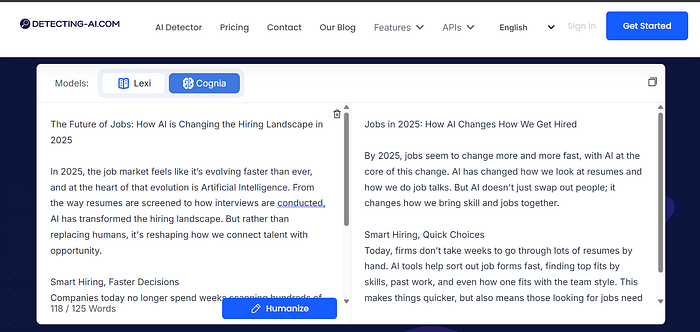
Here are some good sources of protein to add to your meals:
Seafood: Try to have at least two portions a week, including one oily fish like salmon or mackerel.
Poultry and Lean Meats: Pick skinless chicken or turkey and lean cuts of red meat.
Plant-Based Proteins: Add beans, peas, and lentils to soups, stews, and salads.
5. Healthy Fats: Avocados, Olive Oil, and Nuts
While some fats should be limited, your body needs healthy fats to work well. The key is to pick unsaturated fats instead of saturated ones. These better fats can help to lower cholesterol in the blood. Good sources of unsaturated fats include avocados, olive oil, and many nuts and seeds. These foods give essential fatty acids and add flavour and texture to your meals.
Choosing fresh, whole foods for fat instead of processed ones has clear benefits. Fresh foods like avocados and nuts provide nutrients without the unhealthy additives found in many packed snacks. For example, a handful of unsalted nuts is one of the best healthy snacks, giving fibre and healthy fats to keep you full. Using olive oil for cooking or as a salad dressing is an easy way to add healthy fats.
Here are some ways to include more healthy fats in your diet:
Use olive oil as your main cooking oil or pour it over salads.
Add sliced avocados to your toast or salads for a creamy feel and a dose of healthy fat.
Snack on a small amount of unsalted nuts like almonds or walnuts.
How to Identify Truly Healthy Food Products
Shopping in the supermarket can be hard when you want to eat healthily. Many foods say they are healthy, but their packaging can be confusing. So, how can you know if a food is really healthy? The answer is to look past the claims on the front and check the nutrition labels and ingredients list on the back.
To be a smart shopper, you need to learn how to check what is really in your food. By looking at the details, you can make better choices that match your health goals and follow good dietary guidelines. In the next parts, we will look at how to read nutrition labels and find common warning signs like hidden sugars and extra additives.
Understanding Nutrition Labels and Ingredients
To know if a food is healthy, the nutrition label can help you. This label shows the nutrient content for each serving, such as calories, fats, sugars, and salt. When you read the label, first check the serving size. The numbers you see are for that amount, which could be less than what you usually eat.
The ingredients list is also important. Ingredients are shown from the most to the least. If sugar, salt, or bad fats are near the top, it means the product has a lot of these. Also, be careful if the list is long with strange names or chemical words. Food with simple and natural ingredients is usually better.
Here are some things to look for on nutrition labels:
Serving Size: Look at this first to understand the other numbers.
Fat, Sugar, and Salt: Pick foods with less saturated fat, sugars, and salt.
Fibre: Go for foods with more fibre, like whole-grain breads and cereals.
Spotting Hidden Sugars, Additives, and Unnecessary Ingredients
Making healthier choices often means you need to be like a detective when shopping, especially to spot hidden sugars. Sugar comes in many forms and may appear under different names on the label. Words that end with “-ose,” like fructose, sucrose, and maltose, are all sugars. Syrups, nectars, and fruit juice concentrates are also types of sugar.
Besides sugar, it is smart to watch out for long ingredient lists full of additives and things you do not know. Not all additives are bad, but a shorter list usually means the product is less processed and more natural. Getting better nutrition means choosing whole foods, so the fewer extra ingredients, the better. This way also helps you control your calorie intake better.
To help you find less healthy items, remember these tips:
Scan the ingredient list to find many hidden sugars.
Be careful with products that say “low-fat” because they often have added sugar to make them taste better.
Choose products with short, simple ingredient lists that you can easily understand.
Building a Balanced Diet According to Health Experts
So, what does a balanced diet look like according to health experts? It means having variety, the right amounts, and not eating too much or too little. A balanced diet includes foods from all the main food groups to help you get many important nutrients. Following dietary guidelines, like those from the NHS or the USDA, is a good way to plan your meals.
Eating like this helps you keep a healthy weight. It can also lower your chance of getting long-lasting problems like heart disease. The aim is to base your meals on starchy foods with lots of fibre, eat plenty of fruits and vegetables, and have moderate amounts of protein and dairy. In the next parts, we will explain the right portions for each food group and why variety is important.
Recommended Portions of Each Food Group
To create a balanced diet, it helps to know the right servings for each food group. Health guides like the Eatwell Guide or the USDA’s MyPlate show you how to split your plate. Usually, fruits and vegetables should take up the biggest part of your diet, followed by starchy whole grains. A simple daily meal plan might be porridge with fruit for breakfast, a whole-grain sandwich with salad for lunch, and lean protein with lots of vegetables for dinner.
For protein, try to eat some beans, pulses, fish, eggs, or meat every day. Dairy products or their alternatives are also important for calcium. It is best to pick options that have less fat and sugar. Knowing portion sizes is very important. For example, one portion of fruit is about 80g, and a portion of fish is usually about 140g.
Here’s a general guide to the recommended portions:
Fruits and Vegetables: Try for at least 5 portions each day. One portion is about a handful.
Starchy Foods: These should be just over a third of what you eat.
Protein and Dairy: Have moderate amounts every day, choosing lean and low-fat kinds.
The Role of Variety and Moderation in Daily Meals
Two key ideas for healthy eating over a long time are variety and moderation. Eating many different foods helps you get all the vitamins, minerals, and nutrients your body needs to stay well. This means not only eating your favourite vegetables but also adding a variety of vegetables and fruit to your meals each week.
Moderation is just as important. No food needs to be completely avoided. This makes healthy eating easier and more enjoyable for your family. Foods with more fat, salt, or sugar can be eaten sometimes, but in small amounts. This balance stops you from feeling like you are missing out. Healthy snacks, like fruit or unsalted nuts, can help keep hunger away between meals without ruining your healthy habits.
To make healthy eating a family activity, try these ideas:
Let your children help with planning and cooking meals.
Eat meals together as a family regularly to show good eating habits.
Keep mealtimes happy and avoid using food as a reward or punishment.
Frequently Asked Questions (FAQ)
What are some important dietary guidelines to keep a healthy eating routine and prevent heart disease? How can you choose healthier foods, like picking whole grains instead of processed white bread? What are the best protein sources that help with weight loss and lower cholesterol? Find out the health benefits of eating more fruits and vegetables to reduce the chance of heart problems. Learn why it is important to include unsaturated fats and lean meats, while cutting down on saturated fats, to have a balanced diet.
What are the key differences between healthy and unhealthy foods?
The key difference between healthy and unhealthy foods is in their nutrition. Healthy foods, such as fruits, vegetables, and lean proteins, have lots of vitamins, minerals, and fibre. These give many health benefits. On the other hand, unhealthy foods are usually highly processed. They often have large amounts of saturated fat, sugar, salt, and artificial additives. They have very few good nutrients. Eating healthy food all the time helps your well-being. But eating a diet with lots of unhealthy foods can raise your health risks.
Are there any official guidelines or plates that help build a healthy meal?
Yes, there are official dietary guidelines to help you create a healthy and balanced diet. In the UK, the NHS offers the Eatwell Guide. It shows the amounts of each food group you should eat in a simple way. In the United States, the USDA has the MyPlate model. Both these tools divide meals into recommended portions of fruits, vegetables, grains, protein, and dairy. This makes it easier to plan meals that are good for you.
How can I make healthy eating enjoyable and sustainable for my family?
To enjoy healthy eating and keep it going, focus on having a mix of foods and eating in moderation instead of following strict rules. Get your family involved in picking and making meals to make it fun. Try different colourful foods and cook them in new ways. Let yourself have small treats now and then so you don’t feel like you’re missing out. Keeping healthy snacks nearby helps everyone choose better foods during the day. This way, healthy eating becomes an easy and enjoyable part of life.
Conclusion
To sum up, making smart and healthy food choices is very important for improving your overall health. By adding a mix of colourful fruits, leafy greens, whole grains, lean proteins, and healthy fats to your meals, you can create balanced dishes that help your body. Knowing how to read nutrition labels and spotting hidden sugars or additives will help you pick truly healthy foods. Remember, moderation and variety are the keys to a lasting eating plan. This kind of plan not only supports your health but can also be enjoyable for your whole family. If you want to start your journey towards healthier eating habits, get a free consultation with our nutrition experts today!
Here’s a quick look at what we’ll cover in this guide to artificial intelligence:
Artificial intelligence (AI) is a field of computer science creating smart machines that simulate human-like learning and problem-solving.
AI technology is powered by subsets like machine learning and deep learning, which use data to make predictions and decisions.
The evolution of AI has moved from theoretical concepts to practical, real-world tools that we use every day.
There are many AI applications, from virtual assistants and fraud detection to advanced medical diagnostics.
While AI offers huge benefits, it’s vital to consider the ethical challenges, including bias and transparency.
Introduction
Have you ever wondered how your phone recognises your face or how a streaming service recommends the perfect film for you? The answer is artificial intelligence (AI). Far from being just a concept in science fiction, AI is a major part of modern computer science and is woven into our daily lives. It’s one of today’s most transformative technologies, designed to perform tasks that typically require human intelligence. This guide will break down what AI is, how it works, and why it matters to you.
Defining Artificial Intelligence in the Modern World
So, what is artificial intelligence? Simply put, AI is a collection of technologies enabling computers to simulate human intelligence. This means they can learn, reason, problem-solve, and even understand language. AI systems are designed to process information and make decisions, often in ways that mimic our own thinking.
This technology encompasses various subfields, including machine learning and natural language processing, which allow computers to learn from data and interact with us using human language. From its early theoretical stages to its current form, AI has always been about creating machines that can think and act intelligently. We’ll explore how these concepts have evolved and what distinguishes machine intelligence from our own.
Evolution of Artificial Intelligence Concepts
The dream of creating a thinking machine isn’t new, but the modern field of artificial intelligence truly began in the mid-20th century. A key moment was in 1950 when computer science pioneer Alan Turing proposed the “Turing Test.” This test was designed to see if a machine could exhibit intelligent behaviour indistinguishable from a human, a concept that moved AI from science fiction towards a tangible scientific goal.
Just a few years later, in 1956, the term “artificial intelligence” was officially coined by John McCarthy at a conference at Dartmouth College. This event is widely seen as the birth of AI as a formal academic discipline. It brought together researchers who laid the groundwork for the decades of innovation that would follow.
Early successes included programs that could play chess and simple chatbots, but progress was often slow. However, the development of new artificial intelligence techniques and the increasing availability of computing power have led to the AI revolution we see today, transforming those early ideas into powerful, real-world tools.
Differences Between Human and Machine Intelligence
While AI systems are inspired by human intelligence, there are fundamental differences in how they operate. Our intelligence is adaptable, creative, and emotional, deeply connected to the intricate workings of the human brain. We can understand context, apply common sense, and learn from very few examples.
AI systems, on the other hand, excel at processing vast amounts of data to identify patterns and perform specific tasks with incredible speed and accuracy. They display intelligent behavior within their defined parameters but lack genuine consciousness, self-awareness, or feelings. An AI might simulate emotions, but it doesn’t experience them.
The ultimate goal for some researchers is to create artificial general intelligence (AGI), an AI that could learn and reason across a wide range of tasks just like a human. However, current AI is “narrow,” meaning it is highly specialised. This distinction is crucial for understanding both the current capabilities and the future potential of AI technology.
How Artificial Intelligence Works
At its core, artificial intelligence works by using algorithms to analyse data, identify patterns, and make predictions or decisions. Instead of being explicitly programmed for every single task, an AI model learns from experience. The key ingredient in this process is training data, which serves as the material the AI studies to improve its performance.
This learning process is the foundation of machine learning, a major subset of AI. By feeding an AI model huge datasets, it can learn to recognise images, understand speech, or predict outcomes. More advanced systems use deep neural networks, which are complex structures that allow for even more sophisticated learning. Let’s look closer at the fundamental components that make AI work.
Fundamentals of Machine Learning
Machine learning (ML) is a type of AI technology where systems learn from data to identify patterns and make decisions without direct programming. Think of it like teaching a computer to recognise a cat by showing it thousands of cat pictures. Over time, it learns the common features and can identify a cat in a new image on its own.
This process relies heavily on training data. The quality and quantity of this data are crucial for the AI’s performance, as the system’s accuracy is directly tied to the examples it has learned from. The core of ML is pattern recognition; algorithms sift through the data to find relationships and correlations that humans might miss.
There are many types of machine learning, including supervised learning, where data is labelled to guide the AI, and unsupervised learning, where the AI finds hidden patterns in unlabelled data. Each type of machine learning is suited for different kinds of problems, making it a versatile and powerful tool for a wide range of applications.
The Role of Data in AI Learning
Data is the lifeblood of artificial intelligence. Without it, even the most sophisticated AI systems cannot learn or function. The field of data science focuses on collecting, cleaning, and preparing the large amounts of data needed to train AI models effectively. These systems learn by analysing vast data sets to identify underlying patterns and relationships.
The more high-quality data an AI is exposed to, the better it becomes at its task. For example, a fraud detection model becomes more accurate after analysing millions of transactions, learning to spot anomalies that indicate fraudulent activity. This learning isn’t a one-time event; AI systems continuously improve as they are fed new data.
This ability to learn from new data allows AI to adapt and refine its performance over time. Whether it’s a chatbot learning from new conversations or a recommendation engine adjusting to your latest preferences, the constant flow of data is what makes modern AI systems so dynamic and powerful.
Deep Learning and Neural Networks
Deep learning is a more advanced subset of machine learning that uses structures called artificial neural networks. These networks are inspired by the web of neurons in the human brain. A neural network consists of interconnected layers of nodes that work together to process information and make complex decisions.
What makes deep learning “deep” is the use of deep neural networks, which have many layers—sometimes hundreds. This multi-layered structure allows them to analyse data in a more sophisticated way, automatically identifying complex patterns in large, unstructured datasets like images, text, and sound. This is how AI can perform tasks like facial recognition or understanding spoken language.
This process is computationally intensive and often requires powerful hardware like graphical processing units (GPUs) to handle the calculations. Deep learning is the technology behind many of the most impressive AI achievements today, from self-driving cars to generative AI tools that create original content.
Key Types of Artificial Intelligence
When we talk about the different types of AI, we can categorise them based on their capabilities and functionality. One major distinction is between AI that is designed for a specific task and AI that possesses broad, human-like intelligence. This is often framed as the difference between “narrow” and “general” AI.
Currently, all the AI we use is considered narrow. The concept of a machine with artificial general intelligence (AGI), also known as strong AI, remains theoretical. Understanding these different classifications helps us appreciate what AI can do today and what it might achieve in the future. Let’s examine these types in more detail.
Narrow AI versus General AI
The most important distinction in AI today is between Narrow AI and General AI. Artificial Narrow Intelligence (ANI), or narrow AI, is the only form of AI that currently exists. These systems are designed to perform a single, specific task exceptionally well. Examples are all around us, from the voice assistant on your phone to facial recognition software and generative AI models.
Although its AI capabilities are powerful within its predefined scope, narrow AI does not possess reasoning, consciousness, or self-awareness. It simply uses algorithms to make predictions based on the data it was trained on.
In contrast, Artificial General Intelligence (AGI) is a theoretical future form of AI. AGI would possess human-like general intelligence, capable of understanding, learning, and applying knowledge across a wide range of tasks. Unlike narrow AI, an AGI would be adaptive and autonomous, able to learn from its actions and think abstractly. We are still a long way from achieving this level of AI.
Reactive Machines, Limited Memory, and Beyond
Another way to classify AI systems is by their functionality. The simplest type is a reactive machine. These AIs have no memory and only react to current stimuli based on pre-programmed rules. A famous example is IBM’s Deep Blue, the computer that beat chess champion Garry Kasparov in 1997. It analysed the board and made its move without remembering past games.
Most modern AI falls into the “limited memory” category. These systems can use past experiences to inform future decisions, but their memory is short-term. For example, a self-driving car observes the speed and direction of other vehicles to navigate safely, and a chatbot remembers previous messages in a conversation. These abilities enable more complex and useful applications of AI.
The next theoretical steps are “Theory of Mind” AI, which could understand human emotions and thoughts, and “Self-Aware” AI, which would have consciousness. These advanced forms do not exist yet but are the subject of ongoing research and popular use cases in science fiction.
Strong AI, Superintelligence, and Speculation
Beyond general AI, the conversation often turns to even more advanced theoretical concepts. Strong AI, another term for AGI, refers to a machine with intelligence equal to that of a human. This is a staple of science fiction, seen in characters like the droids from Star Wars, but it remains a distant goal for AI research.
The next hypothetical level is Artificial Superintelligence (ASI). This would be an entity that significantly surpasses human intelligence in every field, including scientific creativity, general wisdom, and social skills. The idea of superintelligence raises profound questions and concerns, as an entity operating so far beyond human control could have limitless potential for good or harm.
While these concepts are fascinating, it’s important to remember they are currently in the realm of speculation. Today’s AI research is focused on improving the narrow AI systems we have, but these future possibilities drive much of the long-term thinking and ethical debate within the field.
Current Applications of Artificial Intelligence
The use of AI is no longer a futuristic concept; it’s a present-day reality. AI applications are transforming industries and simplifying our daily routines. From the virtual assistants on our smartphones that answer questions to the complex algorithms that detect financial fraud, AI technology is everywhere.
In business, AI is optimising everything from customer service to supply chains. At home, it personalises our entertainment and helps us navigate our cities. Let’s explore some specific real-world examples of how AI is making a difference in healthcare, business, and our everyday lives.
AI in Healthcare and Medicine
Artificial intelligence is revolutionising health care in remarkable ways. One of the most significant AI applications is in medical imaging. AI-powered computer vision can analyse scans like X-rays and MRIs to help doctors detect diseases like cancer earlier and more accurately than the human eye alone.
AI is also accelerating drug discovery. By analysing vast biological datasets, AI can help researchers identify potential new treatments and predict their effectiveness, a process that used to take years. This dramatically speeds up the development of new medicines, bringing life-saving treatments to patients faster.
Furthermore, AI-guided surgical robotics enable surgeons to perform complex procedures with greater precision and control, reducing the need for extensive human intervention and improving patient outcomes. From transcribing doctors’ notes with speech recognition to personalising treatment plans, AI is becoming an indispensable tool in modern medicine.
Use of AI in UK Business and Commerce
In the UK, businesses are increasingly adopting AI technology to enhance efficiency and gain a competitive edge. AI is being used to automate routine tasks, provide deeper insights from data analytics, and create more personalised customer experiences. This helps companies reduce costs and improve their services.
From retail to finance, AI is making a tangible impact. For example, AI-powered chatbots handle customer service inquiries 24/7, freeing up human agents to deal with more complex issues. In logistics, AI optimises stock management by predicting demand and automating warehouse operations, ensuring products are available when customers need them.
Here are some common ways AI is used in business:
Business Function
AI Application
Customer Service
AI-powered chatbots and virtual assistants for 24/7 support.
Marketing
Personalised product recommendations and targeted advertising.
Finance
Algorithmic trading and advanced fraud detection systems.
Operations
Predictive maintenance for machinery and supply chain optimisation.
Everyday AI: Virtual Assistants and Smart Devices
You might be surprised by how often you interact with artificial intelligence in your daily lives. Virtual assistants like Siri, Alexa, and Google Assistant are prime examples. They use natural language processing to understand your commands, set reminders, play music, and answer your questions in an instant.
Many of the smart devices in our homes are also powered by AI. These devices, part of the growing Internet of Things (IoT), can learn your habits and automate tasks. For example, a smart thermostat can learn your preferred temperature settings and adjust automatically to save energy, while smart security cameras use facial recognition to alert you to unfamiliar visitors.
Other common applications of AI include spam filters that keep your inbox clean, personalised recommendations on streaming and shopping sites, and navigation apps that find the fastest route by analysing real-time traffic data. These tools work so seamlessly that we often don’t even realise the complex AI running behind the scenes.
Benefits and Challenges of Artificial Intelligence
Artificial intelligence is important today because its capabilities offer enormous benefits, from automating repetitive tasks to providing insights that enhance human decision-making. This intelligent behavior allows us to solve complex problems and create new efficiencies across many industries.
However, the rapid adoption of AI also comes with significant challenges. We must address the limitations of current systems, such as the risk of bias in algorithms and a lack of transparency in how they make decisions. Balancing the incredible potential of AI with these risks is one of the key tasks we face today.
Transforming Industries and Society
The impact of AI technology is profound, transforming industries and reshaping our daily lives in countless new ways. In manufacturing, AI-powered robots are automating production lines, improving safety and efficiency. In finance, algorithms analyse market trends in real-time, enabling faster and more informed trading decisions.
AI is also a powerful engine for research and development across various industries. It can accelerate scientific breakthroughs by analysing massive datasets far quicker than any human could. This has huge implications for fields like medicine, materials science, and climate change research, helping us tackle some of the world’s biggest challenges.
Ultimately, AI is important because it augments human capabilities. By handling repetitive or complex data-driven tasks, it frees us up to focus on more creative, strategic, and empathetic work. This partnership between human and machine intelligence is driving innovation and creating new opportunities for growth and progress in society.
Limitations and Risks of Current AI Systems
Despite their power, current AI systems have significant limitations and risks. One of the biggest challenges is that AI is only as good as the data it’s trained on. If the training data reflects existing human biases, the AI will learn and perpetuate them, leading to unfair outcomes in areas like hiring or loan applications.
Another risk is the “black box” problem. Many advanced AI systems are so complex that even their creators can’t fully explain how they arrive at a specific decision. This lack of transparency can be problematic in critical applications where accountability is essential, making it difficult to trust the output without human intervention.
These challenges highlight the need for careful development and oversight. Key risks include:
Algorithmic Bias: AI systems can reinforce societal biases present in training data, leading to discriminatory outcomes.
Data Vulnerabilities: AI models can be susceptible to attacks, such as data poisoning, which can compromise their integrity and lead to incorrect results.
Lack of Common Sense: AI systems lack true understanding and can make nonsensical errors that a human would easily avoid.
Addressing Bias and Transparency in AI
To build trust in AI, we must actively address the issues of bias and transparency. Combating bias starts with the data sets used to train an AI model. Organisations need to ensure that their data is diverse and representative to minimise the risk of creating discriminatory algorithms.
Improving transparency, often called “explainability,” is another crucial step. This involves developing methods that allow users to understand and retrace how an AI model reached its conclusions. When an AI denies a loan application, for example, the applicant should be able to understand the reasoning behind the decision. This is not only ethical but also essential for accountability.
To ensure AI is developed responsibly, we need to focus on several key areas:
Diverse Data Sets: Actively curating and cleaning data to remove inherent biases.
Explainable AI (XAI): Creating models that can articulate their decision-making processes in a way humans can understand.
Protecting Personal Information: Implementing robust privacy measures to protect the data used in AI training and deployment.
Major Organisations Powering AI Research
The rapid advancement of AI is being driven by a global network of dedicated researchers. This AI research is primarily powered by major tech companies and leading universities, which invest billions in developing new models and applications. These organisations are at the forefront of pushing the boundaries of what AI can do.
In the UK, institutions like the Alan Turing Institute play a crucial role in consolidating national efforts and fostering collaboration. Let’s take a look at some of the key players who are shaping the future of artificial intelligence around the world and here at home.
Leading Global Universities and Tech Companies
The field of AI research is dominated by a handful of major global players. On the corporate side, large tech companies like Google, Meta, IBM, and Baidu are investing heavily in their own AI labs. They have access to immense computing power and vast datasets, which allows them to build and train some of the most powerful AI models in existence.
Alongside these corporations, leading universities remain vital hubs of innovation. Institutions like Stanford University, MIT, and Carnegie Mellon University have long-standing AI programmes that produce cutting-edge research and nurture the next generation of AI talent. These academic centres often focus on foundational research that pushes the theoretical limits of the field.
The collaboration between industry and academia is key to progress. Here are some of the key contributors:
Tech Companies: Google (DeepMind), OpenAI, Meta AI, and IBM Research are developing everything from large language models to new AI applications.
Universities: Stanford, MIT, and the University of Cambridge are renowned for their contributions to AI theory and practice.
Open-Source Projects: Initiatives like Meta’s Llama-2 enable smaller developers and researchers to build on powerful foundation models.
The Role of the Alan Turing Institute in the UK
In the UK, the Alan Turing Institute stands as the national institute for data science and artificial intelligence. Named after the visionary computer scientist Alan Turing, the institute was founded to undertake world-class research and apply it to real-world problems. It brings together experts from top universities and industry partners to collaborate on a shared mission.
The Institute’s work covers a broad spectrum of AI research, including foundational areas like machine learning, as well as ethics, safety, and the social impact of AI. Its goal is to make the UK a global leader in AI by fostering a dynamic and collaborative research ecosystem.
By connecting academics, businesses, and public sector organisations, the Alan Turing Institute helps translate theoretical breakthroughs into practical solutions that benefit the economy and society. It plays a pivotal role in shaping the UK’s strategy and capabilities in artificial intelligence, ensuring the nation remains at the forefront of this transformative technology.
Regulation and Governance of AI
As AI technology becomes more powerful and widespread, the need for clear regulation and governance grows. Governments and international bodies are now working to create a policy framework that encourages innovation while protecting citizens from potential harm. The goal is to ensure AI is developed and used safely, ethically, and responsibly.
In Europe, existing rules like the General Data Protection Regulation (GDPR) already apply to AI systems that process personal data. However, new, AI-specific legislation is also being developed. Let’s look at the current regulatory landscape and the future direction of AI policy.
Current UK and EU Regulatory Landscape
The UK and the EU are taking distinct but related approaches to AI regulation. The EU is pioneering a comprehensive, risk-based legal framework known as the AI Act. This policy categorises AI systems based on their potential risk to individuals and society, with stricter rules for high-risk applications like those used in critical infrastructure or law enforcement.
In the UK, the government has so far opted for a more flexible, pro-innovation approach. Rather than creating a single, overarching AI law, the UK’s policy relies on existing regulators in different sectors (like finance and healthcare) to develop context-specific rules for AI. The focus is on a set of guiding principles, such as safety, transparency, and fairness.
Both regions must also consider the General Data Protection Regulation (GDPR), which governs how personal data is used. Since many AI systems rely on personal data, GDPR compliance is a critical part of AI governance across the UK and the EU.
International Co-operation and Future Policy Directions
As AI technology operates across borders, international co-operation on policy and regulation is essential. A fragmented global approach could hinder innovation and create legal uncertainty. For this reason, nations are working together through forums like the G7 and the OECD to establish shared principles for trustworthy AI.
Future policy directions are likely to focus on creating agile and adaptive governance frameworks. As AI technology evolves so rapidly, rigid laws may quickly become outdated. The challenge is to create a policy that can keep pace with innovation while ensuring robust protections are in place.
Key areas for future international efforts include:
Standardisation: Developing common technical standards for AI safety, security, and interoperability.
Shared Research: Collaborating on research into AI safety and ethics to address long-term risks.
Regulatory Harmony: Aligning national regulations to facilitate the responsible international development and deployment of AI.
Ethical Considerations in Artificial Intelligence
Beyond technical challenges and regulation, the rise of AI brings a host of ethical issues to the forefront. How can we ensure that AI systems are fair and don’t perpetuate harmful biases? Who is accountable when an autonomous system makes a mistake? These questions touch on the core of responsible AI development.
Creating a human-centred approach is key. This means designing AI systems that align with our values and serve human well-being. Exploring the ethical and social implications of AI is crucial for building a future where this technology benefits everyone.
Key Ethical and Social Implications
The ethical issues surrounding AI are complex and far-reaching. A primary concern is algorithmic bias. If AI systems are trained on biased data, they can make decisions that reinforce social inequalities in areas like employment, criminal justice, and finance. This raises serious questions about fairness and discrimination.
Privacy is another major ethical concern. AI systems often require vast amounts of data to function, including sensitive personal information. Ensuring this data is collected and used responsibly is critical to protecting individual privacy. The ability of AI to understand human language and analyse behaviour also creates new social implications for surveillance and manipulation.
Key ethical considerations include:
Accountability: Determining who is responsible when an AI system causes harm.
Job Displacement: The social implications of AI automating jobs currently performed by humans.
Autonomy and Control: The philosophical and practical questions raised by increasingly autonomous AI systems.
Ensuring Human-Centred and Responsible AI
Building responsible AI requires a proactive, human-centred approach. This means prioritising human well-being and values throughout the entire lifecycle of an AI system, from its design to its deployment. A key principle is ensuring that there is always meaningful human intervention and oversight.
Organisations developing AI technology have a responsibility to implement ethical guardrails. This includes conducting thorough impact assessments to anticipate potential harms, building diverse and inclusive teams to reduce bias, and committing to transparency in how their AI systems operate. The goal is to create AI that assists and empowers people, rather than replacing human judgement entirely.
To foster a responsible AI ecosystem, several practices are essential:
Ethics by Design: Integrating ethical considerations into the core design and development process.
Robustness and Safety: Rigorously testing AI systems to ensure they behave reliably and safely in real-time situations.
Stakeholder Engagement: Involving a wide range of stakeholders, including ethicists, policymakers, and the public, in conversations about AI’s development.
Conclusion
In summary, understanding artificial intelligence and its impact on our daily lives is crucial as we navigate this rapidly evolving landscape. From revolutionising healthcare to enhancing our everyday experiences with smart devices, AI is transforming industries and society at large. However, it also brings forth challenges that require our attention, such as bias, transparency, and ethical considerations. By staying informed about these developments and participating in discussions around regulation and governance, we can ensure that AI serves humanity positively and responsibly. Embrace the journey of learning about AI, and remember, it’s not just about technology; it’s about how we choose to integrate it into our lives. For further engagement, feel free to reach out and dive deeper into the fascinating world of artificial intelligence!
Frequently Asked Questions
What are the main uses of artificial intelligence today?
In recent years, the use of AI has exploded. Key AI applications include virtual assistants like Siri, personalised recommendation engines on streaming services, fraud detection in banking, and medical image analysis in healthcare. These AI systems show how AI technology is integrated into both our daily lives and specialised industries.
How do artificial intelligence systems improve over time?
AI systems improve through a process called machine learning. They are trained on vast amounts of training data, allowing a neural network to learn patterns. As these systems are exposed to new data from ongoing operations, they continuously refine their algorithms, becoming more accurate and effective over time.
Who is setting the rules for artificial intelligence in the UK?
In the UK, AI governance is guided by a flexible policy framework rather than a single regulation. Existing regulators are responsible for creating rules within their sectors, guided by government principles. The General Data Protection Regulation (GDPR) also plays a key role, covering any AI that processes personal data.